Quantcast
Garnish
Showing posts with label Tiki. Show all posts

Thursday, January 10, 2019

Chartreuse Swizzle

Chartreuse Swizzle

It's January, and you know what that means - it's time to Tiki the Snow Away! This midwinter celebration of all things Tiki was started by Dani DeLuca and Nic Titze. Living in Boston, it's usually a welcome escape from the cold and snow for me. This year is a bit odd - no snow to Tiki away and temperatures in the 40's. It's practically tropical.

If you missed my overview of the Tiki movement and its history last year, check it out. Tiki is all about kitsch and fun and crazy garnishes. It doesn't take itself too seriously. But you'd never be able to tell that given the cocktail recipes it has produced - elaborate, delicious constructions of juices and rums and spices. If you're interested in getting started making your own Tiki cocktails at home, definitely check out Martin Cate's book Smuggler's Cove.

Chartreuse Swizzle

Smuggler's Cove was where I found this recipe for the Chartreuse Swizzle, and I'm so glad I did. With no rum in sight, it's not a traditional Tiki cocktail, but it is a take on a very Tiki sort of drink, the swizzle. Swizzles are built in their tall glasses with crushed ice and traditionally mixed using a swizzle stick - not a little plastic thing like the one in these photos, but an actual branch from the aptly-named Swizzlestick Tree. The stick is rubbed between your palms, kind of like you're a Boy Scout trying to start a fire. The prongs at the bottom spin and mix the drink to frosty perfection. If you don't have a real swizzle stick (I don't), then a barspoon will do.

Chartreuse Swizzle

The Chartreuse Swizzle showcases everyone's favorite liqueur, Green Chartreuse. Mixed with lime, pineapple, and some Velvet Falernum, it's a bright and herbaceous, a perfect canvas for this unique spirit and a real standout among Tiki cocktails.

History: The Chartreuse Swizzle was created by Marcovaldo Dionysos of Smuggler's Cove itself in the early 2000's. It has since become one of the "new classics" of the cocktail world.

Chartreuse Swizzle

Chartreuse Swizzle

1.5 oz. Green Chartreuse
1/2 oz. Velvet Falernum
1 oz. pineapple juice
3/4 lime juice

Combine all ingredients in a tall glass and fill it with crushed ice until it is about 3/4 full. Insert a barspoon or swizzle stick and swizzle until the drink is chilled and the glass is frosty. Top with additional crushed ice. Garnish with a mint sprig and grated nutmeg.

Recipe from Smuggler's Cove: Exotic Cocktails, Rum, and the Cult of Tiki.

Monday, August 27, 2018

Bottle Buy: Apricot Liqueur

Tradewinds Cocktail

I've always wanted this blog to be a resource for people who don't know a lot about making cocktails at home, and part of that has been introducing new ingredients as I add them to my bar and start making cocktails with them. So I was alarmed when I realized I had posted the Periodista without saying a thing about its star ingredient, apricot liqueur. Specifically Rothman & Winter Orchard Apricot.

Apricot liqueur may seem a bit specific or obscure if you've only got limited space in your bar, but it's an ingredient that comes up surprisingly often. It appears in a number of recipes from the early 1900's, and in a lot of rum cocktails and Tiki drinks. Like many ingredients we've discussed, the quality and availability of apricot liqueur declined along with the popularity of the craft cocktail during the mid to late 20th century. But now it's back, and there are tons of classic and new recipes to make with it.

I knew apricot liqueur would be a good buy because I've already made - and loved - several recipes that called for a small amount of it. Not having a bottle, I subbed in a bit of apricot preserves, which really did work pretty well.  But for more apricot-centric drinks like the Periodista and the Tradewinds (below), you need the real thing. And now I can go back and make those other drinks right.

Apricot Liqueur

Apricot liqueur is often referred to as apricot brandy. The two terms are frequently used interchangeably, but I think certain aspects of how the liqueurs are made may prevent the word "brandy" from appearing on the label - likely the addition of fruit and sugars after distillation, although I'm not sure. The quality apricot liqueurs are essentially fruit brandies or eaux-de-vie - spirits distilled from fruit other than grapes, in this case apricots.

One of the easiest bottles of apricot liqueur to find, and the one that seems to be recommended the most often in my cocktail recipe books, is Rothman & Winter, which is imported from Austria by Haus Alpenz. It's made from Klosterneuberger apricots grown in the Danube Valley. Two of the other most popular varieties, Giffard and Marie Brizard, are made in France.

Rothman & Winter Apricot Liqueur

Price: $25
Alcohol Content: 24%
Popular Cocktails: Tradewinds, Periodista, Golden Gun, Flor de Jerez, Charles Lindbergh, Hotel Nacional

Tradewinds Cocktail

It's been a while since I made a genuine Tiki drink, but after a couple of recent trips to Tiki Rock in Boston, I was itching to make one at home. I love drinks with coconut creme - Tiki Rock had a Painkiller that was really amazing - and the Tradewinds had been on my list of drinks to make once I finally got my hands on some apricot liqueur. It's an undeniably tasty cocktail, creamy and tart. The traditional garnish is a lemon wedge speared on an inside-out cocktail umbrella (as if the wind has blown it that way), but I thought a mini pinwheel was appropriate.

History: According to Martin Cate in Smuggler's Cove, the Tradewinds originated in the Caribbean in the 1970's. The recipe appeared in Beachbum Berry Remixed.

Tradewinds Cocktail

Tradewinds

1 oz. black blended rum (Cruzan)
1 oz. blended lightly aged rum (Appleton Estate Signature Blend)
1 oz. apricot liqueur (Rothman & Winter)
1 1/2 oz. coconut cream
1 oz. lemon juice

Combine all ingredients in a shaker with 12 oz. crushed ice and a 4 large "agitator" cubes. Shake or flash blend and then open pour into a zombie or pilsner glass. Garnish with a lemon wedge speared on an inside-out umbrella, or a little pinwheel. I added some mint as well.

Recipe adapted from Smuggler's Cove.

Wednesday, January 31, 2018

Jungle Bird

Jungle Bird

I've got one final Tiki cocktail for you before January's #TikiTheSnowAway campaign ends! It's been a fun month - I tried some new recipes and learned a lot about rum and Tiki drinks. It was definitely a welcome contrast to the cold and snow.

While the Jet Pilot, Navy Grog, and Zombie are all essential Tiki cocktails that date back to the early days of the movement, the Jungle Bird is more like a new classic. It's an extremely popular Tiki cocktail, and one that a lot of other Drinkstagrammers made this month at one point or another. The unique thing about it is the inclusion of Campari, a bitter aperitif that is definitely not part of the traditional Tiki repertoire. As a result, this cocktail provides a fresh take on the usual Tiki formula. It's got all the tropical flavors you expect with a wonderfully bitter twist at the end of your sip. If you like it, you might also enjoy the Bitter Mai Tai, another Tiki drink that includes Campari.

History: The Jungle Bird was invented at the Kuala Lumpur Hilton around 1978. The recipe was included in Beachbum Berry Remixed.

Jungle Bird

Jungle Bird

1 1/2 oz. black blended rum
3/4 oz. Campari
2 oz. pineapple juice
1/2 oz. lime juice
1/2 oz. SC Demerara syrup*

Combine all ingredients in a mixing tin with crushed ice and a few large agitator cubes. Shake well or flash blend and open pour into a Collins or highball glass. Garnish with pineapple leaves.

*For Smuggler's Cove's Demerara syrup, bring 2 parts water to a boil and whisk in 1 part Demerara sugar. Then add 3 parts granulated sugar and stir until dissolved. Let cool before using.

Recipe adapted from Smuggler's Cove.

Friday, January 26, 2018

Zombie

Zombie

Today's #TikiTheSnowAway cocktail is another classic, perhaps second only to the Mai Tai in popularity: the Zombie. I have to say, this cocktail had somewhat negative connotations in my head before I saw the recipe. The name immediately conjured images of sugary cocktails laced with blue curaƧao. And for decades, if you ordered a Zombie at a bar, this is probably what you'd get. As I mentioned in my brief history of Tiki, Donn Beach kept his recipes carefully secret, to the point of using unmarked bottles and mysterious numbered mixtures simply labeled "Spices" or "Dashes." This, combined with the ubiquity of cheap, artificial mixtures in the second half of the 20th century, meant that any Zombie you would order at a Tiki bar would likely be a far cry from Donn's original.

Thankfully, Jeff "Beachbum" Berry is here to save the day again. He managed to find the original recipe, eventually piecing together that "Spices #4" referred to cinnamon syrup. The true Zombie was brought back from the dead, as it were.

Zombie

If you look at the recipe below, you'll see that it contains quite a lot of rum. If you thought the Navy Grog was strong, you should not go anywhere near a  Zombie. I swear I'm not trying to pick the most alcoholic Tiki recipes - these are the classics! But the Zombie is so strong that the menu at Don the Beachcomber informed patrons that there was a two-per-person limit, "for your own safety." As you can imagine, this just made the drink even more popular.

And its popularity is well-deserved. It's surprisingly good considering it's mostly rum. Or maybe that shouldn't be a surprise. The little bit of grapefruit juice does quite a lot, and the two dashes of Herbstura (Don's 1:1 mixture of Herbsaint and Angostura bitters) really adds some nice spice and herbal notes and brings it all together. It's a shockingly sophisticated cocktail.

But you probably should limit yourself to two, just in case.

History: Donn Beach invented the Zombie at Don the Beachcomber in 1934. The popular story is that a hungover businessman asked Donn to make him something to get him through a meeting, and Donn hastily mixed something up. Afterwards, the fellow told Donn that the drink made him feel like a zombie. However, the menu at Don the Beachcomber claimed, much to the contrary, that the cocktail was the result of months of careful experimentation on Donn's part.

Zombie

Zombie

1 1/2 oz. blended aged rum*
1 1/2 oz. column still aged rum*
1 oz. black blended overproof rum*
1/2 oz. Velvet Falernum
3/4 oz. lime juice
1/4 oz. grapefruit juice
1/4 oz. cinnamon syrup**
1 tsp. grenadine
1 dash Herbsaint
1 dash Angostura bitters

Combine all ingredients in a shaker tin with 12 oz. of crushed ice and a few large "agitator" cubes. Shake well or flash blend and open pour into a Zombie or Collins glass. Garnish with a mint sprig; I added a cinnamon stick and some appropriate sineage.

*I recommend checking out Smuggler's Cove for more info on how these rums differ and what brands to buy. I personally don't have a column still aged rum or a black blended overproof rum; I used Appleton Estate Signature Blend (actually a blended column still/pot still rum) and Gosling's Black Seal (which is not overproof). Plantation 5-Year was my blended aged rum. If you don't have a giant rum collection, use what you have - I think you'll still enjoy the cocktail quite a bit!

**For cinnamon syrup, combine 1/2 cup water and 2 cinnamon sticks in a saucepan and bring to a simmer. Add 1 cup sugar and stir to dissolve. Remove from heat and let sit for 12 hours. Then strain out the cinnamon sticks.

Recipe from Don the Beachcomber, adapted by Smuggler's Cove.

Saturday, January 6, 2018

Bar School: Tiki Cocktails

Jet Pilot

Tiki cocktails are an entire pool of drinks that I have barely even dipped my toe into on this blog. I think the Mai Tai and the Mari Koriko are the only ones I've made. At first, this was because I thought I wasn't a huge fan of Tiki. Like many people prior to the recent Tiki renaissance, I thought of Tiki drinks as saccharine beverages filled with fruit juices and cheap rum. After discovering that this is not at all the case, at least not anymore, I swung the other way - Tiki drinks seemed far too complicated, with multiple types of rum, exotic ingredients, and garnishes that even I find elaborate. Tiki was a bit intimidating. But as I've built up my bar, learned more about rum, and eagerly followed a number of other cocktail bloggers and Instagrammers with a healthy appreciation for all things Tiki, I've convinced myself that it's time to break into this world of beautiful, fantastical, delicious cocktails. Especially since this month is the #TikiTheSnowAway campaign on Instagram. Started by Drinkstagrammers Dani DeLuna and  Nic Titze, this opportunity to sip tropical beverages while watching the snow come down outside is hard to pass up. It's time to start learning about Tiki!

Tiki cocktails aren't just tropical drinks. In fact, some of the best known drinks that you might associate with the beach, like the Pina Colada or the Daiquiri, do not qualify. Cocktails like the Singapore Sling or Pegu Club, which actually were invented in southeast Asia, are not technically Tiki. Tiki is a very specific American cultural movement from the 1940's and 50's that involved everything from food to music to architecture. It is heavily influenced by Polynesia, but it's an Americanized homage with an endearing inauthenticity.

The word "tiki" comes from the Maori, the indigenous people of New Zealand. According to their legends, Tiki was the first man. The word also refers to small carvings and figurines that have humanoid shapes. How it became the moniker of a major cultural movement in America is a bit of a long story, one that I'll summarize briefly here. For more details, check out Smuggler's Cove by Martin Cate, where most of the information below came from.

The father of Tiki was a man named Ernest Gantt, who would later come to be known as Donn Beach. He grew up in New Orleans and spent a lot of time in the Caribbean and the South Pacific when he was young. In 1931, at 24 years old, he found himself in Los Angeles with no money and a whole lot of Polynesian souvenirs. He started renting them out to movie sets and consulting for films. Two years later, he opened a bar in Hollywood that would become Don the Beachcomber, after a pseudonym that he used during his less-than-legal activities in the Caribbean.
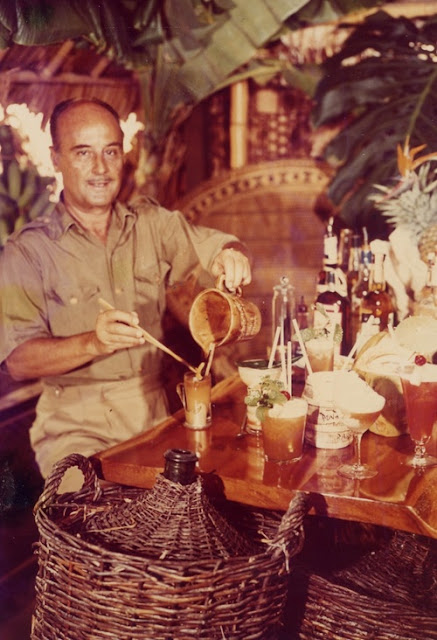
Donn Beach
Don the Beachcomber

The bar was something entirely new. Tropical-themed bars and nightclubs existed, but they were quite elegant and served the same kinds of drinks as everywhere else. Donn's bar was far more rustic and eclectic, designed to look like a beach hut filled with driftwood, fishing gear, and lots of assorted Polynesian artifacts. Donn also created an entirely new kind of drink to be served in this distinctive atmosphere. Working with the base recipe for Planter's Punch, he built cocktails that had "one of sour, two of sweet, three of strong, four of weak." He blended rums and citrus and spices and gave the drinks theatrical names. He also kept the recipes mysterious, using mixtures of ingredients in unmarked bottles so that no one could precisely copy his cocktails.

Don the Beachcomber became incredibly popular. Cate speculates that the Depression was the perfect time for this kind of fantastical, foreign bar experience. It gave people an escape from their troubles and provided a taste of the exotic for those who could not afford to travel. People were enchanted by the entire experience, and no one more so than a fellow named Victor Bergeron.

Trader Vic
Trader Vic

Bergeron owned a small restaurant and bar across from his parents' grocery store in Oakland. He traveled to New Orleans and the Caribbean in hopes of learning to make more exotic cocktails, but it was at Don the Beachcomber that he found his true inspiration. After visiting the bar in 1937, he went home and converted his restaurant into a Polynesian trading post and took the moniker Trader Vic. What Donn Beach had invented, Trader Vic perfected. He served his drinks in fancy mugs with elaborate garnishes. He created tropical cocktails with other spirits besides rum. He even pioneered an entirely new, Americanized twist on Chinese cuisine. The man invented both the Mai Tai and crab rangoon.

As both of these bars grew in popularity and expanded to multiple locations, Tiki exploded. The craze spread across the country, with thatched-roof restaurants filled with Polynesian carvings popping up left and right. But it wouldn't last. By the end of the 1960's, its popularity began to rapidly fade. Cate attributes this to the baby boomers and a growing sense of reality about what was going on in the world. Tiki suddenly seemed inauthentic or even offensive. As bars closed down, their signature recipes were lost. Those establishments that did stick around tried to clumsily reproduce them with the same sugary mixes and synthetic flavors that were popular during that dark age of cocktails. So Tiki got a reputation for being all about tacky decor and bad drinks.

Jeff Beachbum Berry
Jeff "Beachbum" Berry (photo from Liquor.com)

Until recently, that is, when the "Tiki Revivalists" began scouring antique stores for Tiki mugs and piecing together the old recipes in an effort to resurrect the true spirit of Tiki - not just the drinks, but the entire culture of Polynesian Pop that was born alongside them. Modern Tiki legend Jeff "Beachbum" Berry was responsible for rediscovering and distributing many of the classic Tiki cocktail recipes. Slowly but surely, the cocktail world got Tiki fever once again, and it seems like it might be here to stay. You can once again escape to a Polynesian paradise at San Francisco's Smuggler's Cove, Chicago's Three Dots and a Dash, Berry's own Latitude 29 in New Orleans, or countless others across the country. And home bartenders like me can learn to recreate these little pieces of the tropics at home.

So how do you make a Tiki cocktail? While Tiki culture is inspired by Polynesia, the drinks tend to be heavily influenced by Caribbean flavors and liqueurs. As developed by Donn Beach, they usually balance sour (lemon, lime, grapefruit), sweet (syrups, orgeat, grenadine), weak (pineapple juice, seltzer), spirit (traditionally rum), and spice (falernum, allspice liqueur, bitters). In modern Tiki, there has been a lot more experimentation and alteration of this formula, but the general idea is still there.

Jet Pilot

The Jet Pilot is a great starter Tiki cocktail. Invented in the 1950's at the Luau in Beverly Hills (another famous Tiki bar that's worth reading up about), it's a variation on a Zombie. It really shows how complex the flavors in these cocktails can be. Cinnamon, grapefruit, and three different rums offer a deceptively strong and incredibly tasty libation that will instantly transport you into the world of Tiki.

If, like me, you have a limited selection of rums in your home bar, that doesn't mean you can't still make and enjoy these drinks. It's helpful to learn a bit more about rum so that you can decide what the best substitutions will be. I have a little guide here, but I've learned a lot since I wrote it. There's lots of excellent information in Smuggler's Cove, which handily breaks down the rum into categories so you know what the best substitutions are. Other useful guides include this article on Beachbum Berry's six recommended rums and Inu a Kena's Rum 101. For my Jet Pilot, I didn't have a black blended overproof rum, so I subbed in a dark rum. If you're new to Tiki and to rum, it's unlikely that you'll notice too much of a difference!

Jet Pilot

Jet Pilot

1 oz. black blended rum (like Gosling's Black Seal)
3/4 oz. blended aged rum (like Diplomatico Reserva or Appleton Estate Reserve Blend)
3/4 oz. black blended overproof rum (like Lemon Hart 151)
1/2 oz. Velvet Falernum
1/2 oz. lime juice
1/2 oz. grapefruit juice
1/2 oz. cinnamon syrup*
1 dash Herbstura (1:1 Angostura bitters and Herbsaint)

Combine all ingredients in a shaker with crushed ice and a few large cubes. Shake until well chilled and pour into a double Old Fashioned glass or Tiki mug. No garnish is recommended, but feel free to go nuts!

*For cinnamon syrup, combine 1/2 cup water and 2 cinnamon sticks in a saucepan and bring to a simmer. Add 1 cup sugar and stir to dissolve. Remove from heat and let sit for 12 hours. Then strain out the cinnamon sticks.

Recipe adapted from Smuggler's Cove.

Tuesday, August 9, 2016

BƩsame

BƩsame

Even though I've been blogging for over a year now, I think I still fly largely under the radar - while I've been able to connect with a lot of people through Instagram and Twitter, I don't get a ton of traffic or comments here on the blog. Maybe I should be strategizing a bit more about how to change that, but I didn't really start doing this to make money or create a brand - I just really like doing it. You know how they say "Dance like no one's watching?" Well, I think the internet analog to this is "Blog like everyone's watching." It's been fun with or without an audience.

That said, I do get excited when people notice and contact me, and so I was thrilled when Sukkah Hill Spirits asked if I wanted to taste their two products and try them out in some cocktails. I love trying new spirits and I really liked what their company was doing, so of course I said yes. They sent me a few little bottles of their two liqueurs: the sweet and citrusy Etrog and the spice-flavored Besamim. I'll definitely make something with the Etrog soon, but I wanted to experiment with the Besamim first.

Besamim

The Besamim is like autumn in a bottle. Flavored with vanilla, cloves, cinnamon, and nutmeg, it would be delicious with just some bourbon or rye, or mixed with autumn flavors like maple syrup and apple cider. But it's still summer, and I decided the Besamim was begging to be made into a Tiki cocktail. While cinnamon and cloves probably evoke thoughts of pumpkin pie rather than Mai Tais for most people, ingredients like spiced rum, Allspice Dram, and cinnamon syrup regularly find their way into Tiki drinks, and the Besamim is perfect in this role.

I went with a pretty basic recipe using aged rum, lime and grapefruit juice, some demerara simple syrup, and Angostura bitters. If you can't get your hands on the Besamim (Oh but you can! Order it online or see here for retailers that carry it), Allspice Dram would be a good substitute, though you might have to tweak the recipe a bit to get it just right. You could also try throwing some spices into your demerara syrup for a similar effect.

I decided to call this drink the BƩsame (Spanish for "kiss me") because that's what I kept thinking of every time I read the name of the liqueur. It's tart and tropical, with a beautiful spiced flavor from the Besamim. It's everything I want in a Tiki cocktail, and I think I'll drink it for the rest of the summer.

BƩsame

BƩsame

2 oz. aged rum (I used Barbancourt 4 year)
3/4 oz. Besamim liqueur
1/2 oz. lime juice
1/2 oz. grapefruit juice
1/4 oz. demerara simple syrup*
1 dash Angostura bitters

Combine all ingredients in a shaker with ice. Shake until chilled and strain into a rocks glass filled with crushed ice. Top with more crushed ice and garnish with a mint sprig, a lime wheel, and a cinnamon stick. Mwah!

*Demerara simple syrup is just simple syrup made with demerara sugar, a brown, partially refined cane sugar from Guyana. Combine equal parts of the sugar and water and simmer until the sugar is dissolved. Let the syrup cool before using it. You can substitute regular simple syrup, but it won't be as rich as the demerara.

Thursday, May 12, 2016

Mari Koriko

Mari Koriko

Check it out, guys - I've gone full Tiki!

I've mentioned before how intimidated I am by Tiki cocktails, primarily because of how many different rums seem to find their way into a single cocktail. As anyone who reads this blog knows, my budget isn't unlimited, and I'm frequently guilty of substituting ingredients - Scotch for Japanese whiskey, dry vermouth for blanc, triple sec for Cointreau, etc. I would absolutely love to buy five or six different bottles of rum, but it's hard to justify. That said, I do love Tiki cocktails. They're fun, they're utterly drinkable, and they don't take themselves too seriously. And who doesn't love a fun cup and an elaborate garnish? So I hope to slowly ease myself into Tiki with some simpler recipes that use what I've already got in my bar. And in that spirit, I had to buy a Tiki mug. Check out this goofy guy I got from the Boston Shaker!

If you want some great Tiki recipes, check out Fred Yarm's blog Cocktail Virgin Slut. It's great for cocktails of all sorts, but the Tiki glassware and garnishes always catch my eye. It was here that I found the Mari Koriko, a Tiki cocktail that it seemed I could actually make. Dark rum, pineapple juice, Cherry Heering, Falernum, and lime. I know Cherry Heering and Falernum aren't things most people have in their bar, but it just so happens that I have both, and I'd say they're solid investments for your bar as well. Technically the recipe calls for Zacapa rum, an aged Guatemalan rum, but Fred used Gosling's, so that's good enough for me.

As you can maybe guess from the ingredients, the Mari Koriko is fruity and delicious. The dark rum is flavorful enough that it doesn't get swamped out by the other ingredients. I love the Cherry Heering, which gives it a beautiful, rich cherry flavor and, along with the Falernum, a hint of spice.

History: This cocktail comes from Sean Dumke at Knee High Stocking Co. in Seattle via Fred Yarm. There's a fantastic story behind its name. The word Tiki, it turns out, comes from the mythology of the Maori, the native people of New Zealand. In their tradition, Tiki was the first man. And Marikoriko was his wife, the first woman. They're basically the Maori version of Adam and Eve.

I think one reason I was particularly surprised by this is because I associate Tiki cocktails with Polynesia (a kitschy and Americanized version of it, but still), and I never thought of New Zealand as part of Polynesia. But it turns out that it is, both ethnically and geologically.

There's so much you can learn from cocktails!

Mari Koriko

1 1/2 oz. dark rum (Zacapa or Gosling's recommended)
3/4 oz. pineapple juice
1/2 oz. Cherry Heering
1/2 oz. Falernum (I used John D. Taylor's Velvet Falernum)
1/2 oz. lime juice

Combine all ingredients in a shaker with ice and shake until chilled. Strain into a rocks glass or an appropriately kitschy Tiki glass filled with ice. Garnish with a lime wheel and a cherry, or whatever else you can think of.

Recipe from Cocktail Virgin Slut.

Friday, May 8, 2015

Pina Colada

Pina Colada

When I first started drinking, I loved the really sweet stuff. The first things I bought for my bar were Midori, Malibu, and Peach Schnapps. Now the thought of making any of those things the main ingredient in a cocktail makes me nauseous. I guess it's a natural progression.

But that's not to say that sweet, tropical drinks don't have a place in an "adult" cocktail repertoire. Some, like the Mai Tai and the Daiquiri and the Singapore Sling, are still considered respectable when made correctly. Tiki bars seem to be experiencing a small resurgence in our current retro-obsessed craft-cocktail movement (most recently, I went to Beachbum Berry's Latitude 29 in New Orleans and want to go back and try every single thing on the menu). And finally, there are the drinks that are just too good to give up on. The ones that might be meant for sitting beachside but are honestly just as good if you're on your couch. The ones you want to drink in large quantities following a breakup (because whiskey would just be too much of a downer).

The Pina Colada is one such drink.

Say whatever you will about it. I love Pina Coladas (but not getting caught in the rain, that kinda sucks). And there is no way I was going to leave it off of my list of cocktails just because it's a little frou-frou. No. I insist that the Pina Colada is a perfectly respectable cocktail. And I'm going to keep making them. So there.

Pina Colada

History: The Pina Colada was (probably) invented in Puerto Rico in the 1950's or 60's. I say probably because there is a popular legend that it came about long before this, and - like any really good legend - it involves pirates. Specifically, El Pirata Colfresi, Roberto Colfresi. He turned to piracy after his wealthy Puerto Rican family went bankrupt. After the death of Jean Lafitte in 1823, he became the biggest pirate threat in the Caribbean. Legend says that he would give his men a mixture of coconut, pineapple, and rum to improve morale. And thus the Pina Colada was born. Unfortunately, it died with Colfresi as well, when he was executed in 1825.

Much as I love the image of a grisly pirate sipping on a refreshing Pina Colada with a little umbrella in the cup, there isn't really much to back up this story. And even if was true, the recipe was lost. But if you'd like to cling to this bit of Puerto Rican folklore, perhaps it isn't so much who invented the Pina Colada in the 1950's as who rediscovered it.

There are three contenders. First, we have Ramon "Monchito" Marrero Perez, a bartender at the Beachcomber Bar in the Caribe Hilton of San Juan. He is credited with introducing the new drink in either 1952 or 1954. A fellow named Jose L. Diaz de Villegas, supposedly a friend of Monchito's, recently co-authored a book on Puerto Rican cuisine, Puerto Rico: La Gran Cocina del Caribe (in English here). He provides what he considers to be the original recipe. I haven't gotten my hands on a copy of the book yet to confirm that he really does claim to have known Monchito.

Others claim it was not Monchito at all who introduced the Pina Colada at the Caribe Hilton, but a Spanish bartender named Ricardo Garcia. The story goes that he was unable to make the bar's signature drink, the Coco Loco, because the coconut plantation workers had gone on strike. (The bar usually hollowed out a coconut to serve the drink in.) So the resourceful Garcia hollowed out pineapples instead, added some pineapple juice to the mix, and invented the Pina Colada.

Finally, the Barrachina Bar in San Juan also claims credit for the cocktail. Their bartender Ramon Portas Mingot may have invented it in 1963. That's an awfully big time gap for something as delicious as the Pina Colada to stay out of the historical record, but who knows. Maybe everybody was too drunk to write anything down about it.

One thing ties all of the disparate origins of the Pina Colada together: Coco Lopez cream of coconut. This mixture of coconut cream and sugar was created in Puerto Rico in 1948 by Don Ramon Lopez-Irizarry, a scientist and entrepreneur who developed a more effective way to remove the cream from coconuts. Coco Lopez became hugely popular, and the Pina Colada might never have come about without it.

So. If I want to make a Pina Colada, what recipe do I use? There are a ton of variations out there. Most stick to the usual rum/pineapple juice/coconut cream formula, but none seem to have the same proportions. Some, including the "original" recipe on the Caribe Hilton's website, also add cream. Some use white rum, some golden rum.

What's a girl to do but try them all? You know... for science.

Pina Colada

One last note: A few sources say that the original at the Caribe Hilton was shaken, but otherwise a blender is always involved. Unlike the Margarita or the Daiquiri, which pre-date blenders, the Pina Colada was invented well after they came around, so it seems they were meant to be blended.

1. "Original" Pina Colada - Caribe Hilton
     2 oz. white rum
     1 oz. coconut cream
     1 oz. heavy cream
     6 oz. pineapple juice
     1/2 cup crushed ice

The heavy cream in this one gave it an extremely creamy texture. If I let it sit for more than a couple of moments, it would separate and the cream would collect on top. Flavor-wise, it's missing something. The cream muffles the taste of the other ingredients. Plus, it makes an already bad-for-you drink into a true calorie bomb. Not worth it, in my opinion.

2. "Original" Pina Colada - Jose L. Diaz de Villegas
     1 1/2 oz. rum (type not specified, so I went half and half)
     3 oz. coconut cream
     6 oz. pineapple juice
     crushed ice (no amount specified, so I used about 3/4 cup)

Yum. This is my winner. It's the perfect combination of ingredients. I taste the rum, but it's not overpowering. It's the perfect ratio of coconut to pineapple, and the flavor is big and central. Love it.

3. Pina Colada - Esquire/David Wondrich
     2 1/2 oz. golden rum
     1 oz. coconut cream
     3 oz. pineapple juice
     1 cup crushed ice or 5-6 ice cubes

Notably higher in alcohol content than the others, this one tasted too boozy. I have no objection to strong drinks if they're well-balanced, but I really want to taste the pineapple and coconut in this one. I think the ice contributed to it as well. If it sat for a while, it got watered down. It also separated as quickly as the Caribe Hilton recipe.

4. Pina Colada - Liquor.com
     1 1/2 oz. light or gold rum (I used half and half)
     2 oz. coconut cream
     2 oz. pineapple juice
     Ice (no amount specified; I used 3/4 cup)

This one is also good, especially if you like a higher ratio of coconut to pineapple. For me, it was just a bit too sweet and coconuty. I'd happily drink it if you gave me one, but when I compare it to the recipe by Diaz de Villegas, it lacks the nice tang of pineapple. Just a note: I had to increase the recipe by 50% to reach the volume of the others.

So here is the winner. You're welcome.

Pina Colada

1 1/2 oz. white or golden rum (or half and half)
3 oz. coconut cream
6 oz. pineapple juice
~3/4 cup ice

Combine ingredients in a blender and blend until smooth. Garnish with a slice of pineapple and a cherry. Don't be ashamed - it's delicious.

Recipe from Wikipedia, probably taken from Puerto Rico: La Gran Cocina del Caribe.

Tuesday, April 21, 2015

Mai Tai


Mai Tai

There are a few ingredients that pop up frequently enough in different cocktail recipes that they sound familiar, but not frequently enough that I even know what they are. Orgeat syrup is one such ingredient. But when I saw it at a liquor store for less than $20, I decided to try it out. I love when a small investment can greatly increase your cocktail repertoire.

As it turns out, orgeat syrup is made from almonds, sugar, and rose water or orange flower water. It is very sweet and a little almondy, which I absolutely love. There are several different brands out there; I bought this bottle by Fee Brothers.

The most well-known cocktail containing orgeat is the Mai Tai. Like many fruity, rum-based cocktails, this drink has been corrupted by many touristy bars into something that barely resembles the original recipe. The only fruit juice in a real Mai Tai is lime. The rest of its fruity flavor comes from orange curacao, and orgeat gives it its sweetness. It's quite simply delicious. Still tropical enough to be fit for the beach, but not so ridiculously tiki-themed that you don't feel like you can mix one up at home.

History: The Mai Tai falls under the category of "tiki drinks," fruity, usually rum-based cocktails that became popular in the 50's when Polynesian-themed tiki bars and restaurants were all the rage. The two fathers of tiki cocktails are Vic Bergeron ("Trader Vic") and Don the Beachcomber, who ran competing restaurants in Hollywood. Both take credit for the invention of the Mai Tai, but Vic's claim seems most valid. His 1947 bartender's guide tells the story of how it got its name: he served the first one to a Tahitian friend who exclaimed, "Maita'i roa ai!" ("Very good!").

You want to use an aged rum in this cocktail. In fact, Trader Vic was spurred to create it to complement a particularly flavorful bottle of 17-year-old Jamaican rum.

Mai Tai

2 oz. aged rum
3/4 oz. orange curacao
3/4 oz. lime juice
1/2 oz. orgeat syrup

Combine all ingredients in a shaker over ice. Shake until chilled. Strain into a rocks glass filled with ice. Garnish with a mint leaf and a slice of lime (or edible orchids if you're lucky enough to have them).

Recipe from Vintage Cocktails.