Quantcast
Garnish
Showing posts with label Cinnamon Simple Syrup. Show all posts

Wednesday, January 16, 2019

Ursa Major with Bärenjäger Honey & Bourbon

Ursa Major with Barenjager Honey and Bourbon

Winter seems to have finally caught up with us here in Boston, and it's time to break out the hot toddies. The only thing cozier than a steaming mug of tea is a steaming mug of tea and whiskey. Or whatever your spirit of choice might be. If you're on the fence, I've got the perfect suggestion: Bärenjäger Honey & Bourbon.

Bärenjäger (which translates to "bear hunter") has been making a delicious Honey Liqueur for over a hundred years. It was supposedly formulated by bear hunters to lure bears out of their dens, and is sometimes called Bärenfang ("bear trap").

Barenjager Honey and Bourbon

Recently, Bärenjäger got the genius idea to mix their honey liqueur with bourbon, and Bärenjäger Honey & Bourbon was born. One taste of this stuff and you won't want to pick up a bottle of Jack Daniels ever again. The flavor in Bärenjäger is pure, natural honey. It's definitely on the sweet side, but if that's your thing you're going to love sipping on it. Otherwise it's a fantastic addition to cocktails.

Ursa Major with Barenjager Honey and Bourbon

The honey flavor and the cold weather got me thinking of how I would drink black tea with honey when I was sick as a kid. Honey and tea are a natural match, so a hot toddy seemed like the perfect drink for Bärenjäger. With a little Allspice Dram, lemon, and cinnamon syrup, you're going to want to curl up with one of these all winter long. And I'm thinking an iced version is going to have to happen this summer. Maybe with some ginger liqueur instead of the Allspice Dram? The possibilities are endless.

Ursa Major with Barenjager Honey and Bourbon

Ursa Major

1 1/2 oz. Bärenjäger Honey & Bourbon
1/2 oz. Allspice Dram
1/2 oz. lemon juice
1/4 oz. cinnamon syrup*
1 oz. hot water
3 oz. brewed hot black tea

Combine all ingredients in a mug and stir gently. Garnish with star anise.

*For cinnamon syrup, bring 1/2 cup water to a boil in a saucepan. Add 1 cup sugar and stir until dissolved. Add 2 cinnamon sticks, broken into pieces, and let simmer for a minute or so. Remove from heat, cover, and let sit for at least four hours and up to 12 hours. Fine-strain before using.

This post was sponsored by Bärenjäger. All opinions are my own.

Friday, January 26, 2018

Zombie

Zombie

Today's #TikiTheSnowAway cocktail is another classic, perhaps second only to the Mai Tai in popularity: the Zombie. I have to say, this cocktail had somewhat negative connotations in my head before I saw the recipe. The name immediately conjured images of sugary cocktails laced with blue curaçao. And for decades, if you ordered a Zombie at a bar, this is probably what you'd get. As I mentioned in my brief history of Tiki, Donn Beach kept his recipes carefully secret, to the point of using unmarked bottles and mysterious numbered mixtures simply labeled "Spices" or "Dashes." This, combined with the ubiquity of cheap, artificial mixtures in the second half of the 20th century, meant that any Zombie you would order at a Tiki bar would likely be a far cry from Donn's original.

Thankfully, Jeff "Beachbum" Berry is here to save the day again. He managed to find the original recipe, eventually piecing together that "Spices #4" referred to cinnamon syrup. The true Zombie was brought back from the dead, as it were.

Zombie

If you look at the recipe below, you'll see that it contains quite a lot of rum. If you thought the Navy Grog was strong, you should not go anywhere near a  Zombie. I swear I'm not trying to pick the most alcoholic Tiki recipes - these are the classics! But the Zombie is so strong that the menu at Don the Beachcomber informed patrons that there was a two-per-person limit, "for your own safety." As you can imagine, this just made the drink even more popular.

And its popularity is well-deserved. It's surprisingly good considering it's mostly rum. Or maybe that shouldn't be a surprise. The little bit of grapefruit juice does quite a lot, and the two dashes of Herbstura (Don's 1:1 mixture of Herbsaint and Angostura bitters) really adds some nice spice and herbal notes and brings it all together. It's a shockingly sophisticated cocktail.

But you probably should limit yourself to two, just in case.

History: Donn Beach invented the Zombie at Don the Beachcomber in 1934. The popular story is that a hungover businessman asked Donn to make him something to get him through a meeting, and Donn hastily mixed something up. Afterwards, the fellow told Donn that the drink made him feel like a zombie. However, the menu at Don the Beachcomber claimed, much to the contrary, that the cocktail was the result of months of careful experimentation on Donn's part.

Zombie

Zombie

1 1/2 oz. blended aged rum*
1 1/2 oz. column still aged rum*
1 oz. black blended overproof rum*
1/2 oz. Velvet Falernum
3/4 oz. lime juice
1/4 oz. grapefruit juice
1/4 oz. cinnamon syrup**
1 tsp. grenadine
1 dash Herbsaint
1 dash Angostura bitters

Combine all ingredients in a shaker tin with 12 oz. of crushed ice and a few large "agitator" cubes. Shake well or flash blend and open pour into a Zombie or Collins glass. Garnish with a mint sprig; I added a cinnamon stick and some appropriate sineage.

*I recommend checking out Smuggler's Cove for more info on how these rums differ and what brands to buy. I personally don't have a column still aged rum or a black blended overproof rum; I used Appleton Estate Signature Blend (actually a blended column still/pot still rum) and Gosling's Black Seal (which is not overproof). Plantation 5-Year was my blended aged rum. If you don't have a giant rum collection, use what you have - I think you'll still enjoy the cocktail quite a bit!

**For cinnamon syrup, combine 1/2 cup water and 2 cinnamon sticks in a saucepan and bring to a simmer. Add 1 cup sugar and stir to dissolve. Remove from heat and let sit for 12 hours. Then strain out the cinnamon sticks.

Recipe from Don the Beachcomber, adapted by Smuggler's Cove.

Saturday, January 6, 2018

Bar School: Tiki Cocktails

Jet Pilot

Tiki cocktails are an entire pool of drinks that I have barely even dipped my toe into on this blog. I think the Mai Tai and the Mari Koriko are the only ones I've made. At first, this was because I thought I wasn't a huge fan of Tiki. Like many people prior to the recent Tiki renaissance, I thought of Tiki drinks as saccharine beverages filled with fruit juices and cheap rum. After discovering that this is not at all the case, at least not anymore, I swung the other way - Tiki drinks seemed far too complicated, with multiple types of rum, exotic ingredients, and garnishes that even I find elaborate. Tiki was a bit intimidating. But as I've built up my bar, learned more about rum, and eagerly followed a number of other cocktail bloggers and Instagrammers with a healthy appreciation for all things Tiki, I've convinced myself that it's time to break into this world of beautiful, fantastical, delicious cocktails. Especially since this month is the #TikiTheSnowAway campaign on Instagram. Started by Drinkstagrammers Dani DeLuna and  Nic Titze, this opportunity to sip tropical beverages while watching the snow come down outside is hard to pass up. It's time to start learning about Tiki!

Tiki cocktails aren't just tropical drinks. In fact, some of the best known drinks that you might associate with the beach, like the Pina Colada or the Daiquiri, do not qualify. Cocktails like the Singapore Sling or Pegu Club, which actually were invented in southeast Asia, are not technically Tiki. Tiki is a very specific American cultural movement from the 1940's and 50's that involved everything from food to music to architecture. It is heavily influenced by Polynesia, but it's an Americanized homage with an endearing inauthenticity.

The word "tiki" comes from the Maori, the indigenous people of New Zealand. According to their legends, Tiki was the first man. The word also refers to small carvings and figurines that have humanoid shapes. How it became the moniker of a major cultural movement in America is a bit of a long story, one that I'll summarize briefly here. For more details, check out Smuggler's Cove by Martin Cate, where most of the information below came from.

The father of Tiki was a man named Ernest Gantt, who would later come to be known as Donn Beach. He grew up in New Orleans and spent a lot of time in the Caribbean and the South Pacific when he was young. In 1931, at 24 years old, he found himself in Los Angeles with no money and a whole lot of Polynesian souvenirs. He started renting them out to movie sets and consulting for films. Two years later, he opened a bar in Hollywood that would become Don the Beachcomber, after a pseudonym that he used during his less-than-legal activities in the Caribbean.
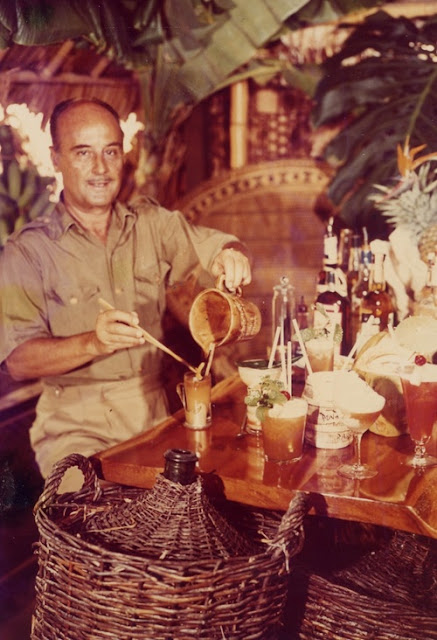
Donn Beach
Don the Beachcomber

The bar was something entirely new. Tropical-themed bars and nightclubs existed, but they were quite elegant and served the same kinds of drinks as everywhere else. Donn's bar was far more rustic and eclectic, designed to look like a beach hut filled with driftwood, fishing gear, and lots of assorted Polynesian artifacts. Donn also created an entirely new kind of drink to be served in this distinctive atmosphere. Working with the base recipe for Planter's Punch, he built cocktails that had "one of sour, two of sweet, three of strong, four of weak." He blended rums and citrus and spices and gave the drinks theatrical names. He also kept the recipes mysterious, using mixtures of ingredients in unmarked bottles so that no one could precisely copy his cocktails.

Don the Beachcomber became incredibly popular. Cate speculates that the Depression was the perfect time for this kind of fantastical, foreign bar experience. It gave people an escape from their troubles and provided a taste of the exotic for those who could not afford to travel. People were enchanted by the entire experience, and no one more so than a fellow named Victor Bergeron.

Trader Vic
Trader Vic

Bergeron owned a small restaurant and bar across from his parents' grocery store in Oakland. He traveled to New Orleans and the Caribbean in hopes of learning to make more exotic cocktails, but it was at Don the Beachcomber that he found his true inspiration. After visiting the bar in 1937, he went home and converted his restaurant into a Polynesian trading post and took the moniker Trader Vic. What Donn Beach had invented, Trader Vic perfected. He served his drinks in fancy mugs with elaborate garnishes. He created tropical cocktails with other spirits besides rum. He even pioneered an entirely new, Americanized twist on Chinese cuisine. The man invented both the Mai Tai and crab rangoon.

As both of these bars grew in popularity and expanded to multiple locations, Tiki exploded. The craze spread across the country, with thatched-roof restaurants filled with Polynesian carvings popping up left and right. But it wouldn't last. By the end of the 1960's, its popularity began to rapidly fade. Cate attributes this to the baby boomers and a growing sense of reality about what was going on in the world. Tiki suddenly seemed inauthentic or even offensive. As bars closed down, their signature recipes were lost. Those establishments that did stick around tried to clumsily reproduce them with the same sugary mixes and synthetic flavors that were popular during that dark age of cocktails. So Tiki got a reputation for being all about tacky decor and bad drinks.

Jeff Beachbum Berry
Jeff "Beachbum" Berry (photo from Liquor.com)

Until recently, that is, when the "Tiki Revivalists" began scouring antique stores for Tiki mugs and piecing together the old recipes in an effort to resurrect the true spirit of Tiki - not just the drinks, but the entire culture of Polynesian Pop that was born alongside them. Modern Tiki legend Jeff "Beachbum" Berry was responsible for rediscovering and distributing many of the classic Tiki cocktail recipes. Slowly but surely, the cocktail world got Tiki fever once again, and it seems like it might be here to stay. You can once again escape to a Polynesian paradise at San Francisco's Smuggler's Cove, Chicago's Three Dots and a Dash, Berry's own Latitude 29 in New Orleans, or countless others across the country. And home bartenders like me can learn to recreate these little pieces of the tropics at home.

So how do you make a Tiki cocktail? While Tiki culture is inspired by Polynesia, the drinks tend to be heavily influenced by Caribbean flavors and liqueurs. As developed by Donn Beach, they usually balance sour (lemon, lime, grapefruit), sweet (syrups, orgeat, grenadine), weak (pineapple juice, seltzer), spirit (traditionally rum), and spice (falernum, allspice liqueur, bitters). In modern Tiki, there has been a lot more experimentation and alteration of this formula, but the general idea is still there.

Jet Pilot

The Jet Pilot is a great starter Tiki cocktail. Invented in the 1950's at the Luau in Beverly Hills (another famous Tiki bar that's worth reading up about), it's a variation on a Zombie. It really shows how complex the flavors in these cocktails can be. Cinnamon, grapefruit, and three different rums offer a deceptively strong and incredibly tasty libation that will instantly transport you into the world of Tiki.

If, like me, you have a limited selection of rums in your home bar, that doesn't mean you can't still make and enjoy these drinks. It's helpful to learn a bit more about rum so that you can decide what the best substitutions will be. I have a little guide here, but I've learned a lot since I wrote it. There's lots of excellent information in Smuggler's Cove, which handily breaks down the rum into categories so you know what the best substitutions are. Other useful guides include this article on Beachbum Berry's six recommended rums and Inu a Kena's Rum 101. For my Jet Pilot, I didn't have a black blended overproof rum, so I subbed in a dark rum. If you're new to Tiki and to rum, it's unlikely that you'll notice too much of a difference!

Jet Pilot

Jet Pilot

1 oz. black blended rum (like Gosling's Black Seal)
3/4 oz. blended aged rum (like Diplomatico Reserva or Appleton Estate Reserve Blend)
3/4 oz. black blended overproof rum (like Lemon Hart 151)
1/2 oz. Velvet Falernum
1/2 oz. lime juice
1/2 oz. grapefruit juice
1/2 oz. cinnamon syrup*
1 dash Herbstura (1:1 Angostura bitters and Herbsaint)

Combine all ingredients in a shaker with crushed ice and a few large cubes. Shake until well chilled and pour into a double Old Fashioned glass or Tiki mug. No garnish is recommended, but feel free to go nuts!

*For cinnamon syrup, combine 1/2 cup water and 2 cinnamon sticks in a saucepan and bring to a simmer. Add 1 cup sugar and stir to dissolve. Remove from heat and let sit for 12 hours. Then strain out the cinnamon sticks.

Recipe adapted from Smuggler's Cove.

Thursday, January 21, 2016

Boukman Daiquiri

Boukman Daiquiri

I never realized how much I liked the Daiquiri until I made a proper one, with nothing but rum, lime juice, and simple syrup. Once I understood what this cocktail was really like in its original, pared-down form, I thought there had to be some variations I could try. My own ideas, while probably still refreshing, weren't that spectacular (Peach daiquiri anyone? Pineapple?). The really good daiquiri riffs do more than just toss in some fruit. The Hemingway Daiquiri is probably the most famous, with maraschino liqueur and grapefruit juice. Now I'm adding the Boukman Daiquiri to the list.

The Boukman Daiquiri does not smother the original recipe in fruits and flavorings, nor does it even change it quite so much as the Hemingway Daiquiri does. It simply switches out a bit of the rum for Cognac, and the usual simple syrup for cinnamon syrup. It preserves the spirit and flavor of the daiquiri while - dare I say? - improving on it. The Cognac and cinnamon syrup give it an incredible depth of flavor that the traditional daiquiri lacks. It's richer. A gorgeous cocktail in every way. If you've never made one, I highly recommend trying it.

As with a traditional daiquiri, your choice of rum is going to really affect the cocktail. I used Bully Boy white rum, made in Boston. It's incredibly flavorful and really shines in a drink like this.

History: The Boukman Daiquiri was created by Alex Day for the Franklin Mortgage and Investment Company in Philadelphia (which, yes, is a bar - looks like maybe they recently changed their name to better reflect that fact). He named it after Dutty Boukman, a Haitian slave and Voodoo priest. In 1791, Boukman presided over an infamous ceremony at a place called Bois Caïman. There was some dancing, prophesies were made, plenty of pig blood was consumed, and Boukman and his fellow priests encouraged the Haitian slaves to revolt. This led to the Haitian Revolution. Boukman was killed by the French three months later, and they put his head on display to let everybody know it. It took years, but Haiti finally gained independence in 1804.

Boukman Daiquiri

Boukman Daiquiri

1 1/2 oz. white rum
1/2 oz. Cognac
3/4 oz. lime juice
3/4 oz. cinnamon simple syrup*

Combine all ingredients in a shaker with ice and shake until chilled. Strain into a cocktail glass and garnish with a slice of lime.

*For cinnamon simple syrup, combine 1 cup of sugar and 1 cup of water in a saucepan with 4 cinnamon sticks broken into pieces. Bring to a boil and then reduce the heat, letting the mixture simmer for 8-10 minutes, stirring frequently. Remove from heat and let cool completely before use.

Recipe from Imbibe.

Wednesday, December 23, 2015

Cinnsation

Cinnsation

Boston has been unseasonably warm this December. Though I worry about what it means for the future (both in terms of how much snow we're destined to get in January and, you know, this whole global climate change thing), it's actually pretty nice not to have to bundle up in multiple layers with gloves and a hat and snow boots every time you want to walk the dog. Besides, it still felt like Christmas to me. I grew up in Louisiana, where Christmas temperatures in the 40's and 50's are not unusual.

But then I flew down to Louisiana on Sunday, and it turns out that temperatures in the 50's in Boston translate to temperatures in the 70's here. It does not feel like Christmas. I didn't bring nearly enough short-sleeved shirts. We usually light a fire every evening, but it's way too warm for it. I can't even bring myself to have the dog try on his brand-new Christmas sweater; it just seems cruel.

So obviously we're not making batches of Hot Toddies here. But the Cinnsation is actually the perfect cocktail for this weather. It's cool and refreshing, but its flavors of tart apple, smoky mezcal, and spicy cinnamon are perfect for the winter we wish we were having. It evokes spice cake and warm apple cider and sitting by the fire. It's a warm-weather winter cocktail.

The recipe calls for an aged mezcal, but lacking that I used mezcal joven and was still quite happy with the cocktail. I can definitely see how the flavor of an aged mezcal would be even better. I never think of mezcal as a holiday spirit, but the smoky flavor is really perfect for the season.

Cinnsation

History: The Cinnsation was created by Phil Ward at Mayahuel in Manhattan. Ward is also the mastermind behind the Division Bell and the Oaxaca Old Fashioned. I'm headed to NYC in early January and Mayahuel is on my list of must-visit bars.

Cinnsation

1 1/2 oz. aged mezcal
1 1/2 oz. mulled apple cider*
3/4 oz. lemon juice
1/2 oz. cinnamon syrup**
1 dash Peychaud's bitters

Combine all ingredients in a shaker with ice and shake until chilled. Strain into an ice-filled highball glass and garnish with an apple slice and a cinnamon stick.

*You can buy mulled apple cider, but you can also make it by adding spices to plain cider. I kept it simple and just added two cinnamon sticks, several cloves, and a bit of grated nutmeg to a cup of cider, letting it infuse for a few hours.

**For cinnamon syrup, combine 1 cup of sugar and 1 cup of water in a saucepan with 4 cinnamon sticks broken into pieces. Bring to a boil and then reduce the heat, letting the mixture simmer for 8-10 minutes, stirring frequently. Remove from heat and let cool completely before use.

Recipe from Imbibe.

Monday, September 7, 2015

Mezcal Smash

Mezcal Smash

There's an entire shelf in my apartment dedicated to old issues of Food & Wine and Bon Appetit that I've never looked at. I mean, I'm not just going to throw them away. They're filled with recipes! It turns out they're just about all on the internet, and you can even browse by individual issues, so the magazines are kind of redundant. But, much to the consternation of the poor movers who transferred at least two boxes of magazines to our new apartment, I insist upon looking through them before I throw them into the recycling bin. I did, at least, cancel my subscriptions once I accumulated a significant pile.

After my defense I finally found time to flip through a few issues. I went for all the summer ones to get some seasonally-appropriate recipes. The August 2012 issue of Bon Appetit had a whole double-page of smash recipes, including the Strawberry Balsamic Smash and this one, the Mezcal Smash. Since I love mezcal, I knew I had to try this one as well.

Mezcal Smash

I was intrigued by the lack of any citrus juice in the recipe, and ultimately I felt like it was a major flaw. It was just too sweet without it. But just a bit of lime juice rounded it out perfectly to my taste. The cinnamon simple syrup is a really nice compliment to the mezcal, and the pineapple flavor ends up pretty subtle. The smoky taste of the mezcal is front and center, but it's definitely softened. This would be a good gateway cocktail for mezcal skeptics. If you're sure you don't like mezcal, you could substitute in tequila instead, but I'd go for an anejo or reposado to make up for the lost flavor.

History: This Mezcal Smash was invented by Damon Boelte of Prime Meats in Brooklyn, NY.

Mezcal Smash

Mezcal Smash

2 oz. mezcal
3/4 oz. cinnamon simple syrup*
1/4 oz. lime juice
2 1-inch cubes fresh pineapple

Place pineapple, cinnamon simple syrup, and lime juice at the bottom of a shaker or mixing glass and muddle to release the juices. Add mezcal. Double-strain into a rocks glass. Fill halfway with crushed ice and stir. Top with more crushed ice and garnish with a cinnamon stick and a pineapple leaf.

*For cinnamon simple syrup: combine 1 cup sugar in 1 cup water in a saucepan and simmer until sugar is dissolved, stirring. Add 3 cinnamon sticks and let steep, uncovered, until cinnamon flavor has infused the syrup. (I only used 1/4 cup each of sugar and water and steeped one cinnamon stick in it for about 3 hours.)

Recipe from Bon Appetit.