Quantcast
Garnish
Showing posts with label Grapefruit Juice. Show all posts

Friday, January 26, 2018

Zombie

Zombie

Today's #TikiTheSnowAway cocktail is another classic, perhaps second only to the Mai Tai in popularity: the Zombie. I have to say, this cocktail had somewhat negative connotations in my head before I saw the recipe. The name immediately conjured images of sugary cocktails laced with blue curaƧao. And for decades, if you ordered a Zombie at a bar, this is probably what you'd get. As I mentioned in my brief history of Tiki, Donn Beach kept his recipes carefully secret, to the point of using unmarked bottles and mysterious numbered mixtures simply labeled "Spices" or "Dashes." This, combined with the ubiquity of cheap, artificial mixtures in the second half of the 20th century, meant that any Zombie you would order at a Tiki bar would likely be a far cry from Donn's original.

Thankfully, Jeff "Beachbum" Berry is here to save the day again. He managed to find the original recipe, eventually piecing together that "Spices #4" referred to cinnamon syrup. The true Zombie was brought back from the dead, as it were.

Zombie

If you look at the recipe below, you'll see that it contains quite a lot of rum. If you thought the Navy Grog was strong, you should not go anywhere near a  Zombie. I swear I'm not trying to pick the most alcoholic Tiki recipes - these are the classics! But the Zombie is so strong that the menu at Don the Beachcomber informed patrons that there was a two-per-person limit, "for your own safety." As you can imagine, this just made the drink even more popular.

And its popularity is well-deserved. It's surprisingly good considering it's mostly rum. Or maybe that shouldn't be a surprise. The little bit of grapefruit juice does quite a lot, and the two dashes of Herbstura (Don's 1:1 mixture of Herbsaint and Angostura bitters) really adds some nice spice and herbal notes and brings it all together. It's a shockingly sophisticated cocktail.

But you probably should limit yourself to two, just in case.

History: Donn Beach invented the Zombie at Don the Beachcomber in 1934. The popular story is that a hungover businessman asked Donn to make him something to get him through a meeting, and Donn hastily mixed something up. Afterwards, the fellow told Donn that the drink made him feel like a zombie. However, the menu at Don the Beachcomber claimed, much to the contrary, that the cocktail was the result of months of careful experimentation on Donn's part.

Zombie

Zombie

1 1/2 oz. blended aged rum*
1 1/2 oz. column still aged rum*
1 oz. black blended overproof rum*
1/2 oz. Velvet Falernum
3/4 oz. lime juice
1/4 oz. grapefruit juice
1/4 oz. cinnamon syrup**
1 tsp. grenadine
1 dash Herbsaint
1 dash Angostura bitters

Combine all ingredients in a shaker tin with 12 oz. of crushed ice and a few large "agitator" cubes. Shake well or flash blend and open pour into a Zombie or Collins glass. Garnish with a mint sprig; I added a cinnamon stick and some appropriate sineage.

*I recommend checking out Smuggler's Cove for more info on how these rums differ and what brands to buy. I personally don't have a column still aged rum or a black blended overproof rum; I used Appleton Estate Signature Blend (actually a blended column still/pot still rum) and Gosling's Black Seal (which is not overproof). Plantation 5-Year was my blended aged rum. If you don't have a giant rum collection, use what you have - I think you'll still enjoy the cocktail quite a bit!

**For cinnamon syrup, combine 1/2 cup water and 2 cinnamon sticks in a saucepan and bring to a simmer. Add 1 cup sugar and stir to dissolve. Remove from heat and let sit for 12 hours. Then strain out the cinnamon sticks.

Recipe from Don the Beachcomber, adapted by Smuggler's Cove.

Monday, January 15, 2018

Navy Grog

Navy Grog

Tiki the Snow Away continues! So far we're getting mixed results - the foot of snow that fell last week melted away this weekend as temperatures neared the 50's in Boston, but unfortunately it did not last and we had another snowfall this morning. We are clearly not Tiki-ing hard enough.

While all that snow was falling last week, I was inside with my nose tucked in Smuggler's Cove, reading about the history of Tiki drinks and the techniques used to make them. I was pretty intrigued when I got to the section about making ice shells and cones. The book indicated that you needed something called "snow ice" for this, and thanks to the blizzard I had plenty of that. I scooped up some freshly-fallen snow and packed it into a champagne flute to make an ice cone. As I learned, this is the traditional garnish for a Navy Grog, and that sounded like a pretty great Tiki drink to try next.

Navy Grog is notoriously strong, containing 1 oz. apiece of three different rums. In fact, its potency is a matter of legal record, as one of the bartenders at Trader Vics in Hollywood testified as to how strong of a drink it was in the trial of Phil Spector, who was accused of murdering actress Lana Clarkson after downing two of them at the bar. So maybe sip yours slowly. Even if the lime, grapefruit, and Allspice Dram make it deceptively drinkable.

Navy Grog

History: Navy Grog was invented by Donn Beach, the father of all things Tiki. Containing a pretty hefty amount of rum, it was the "manly" drink on a menu otherwise populated by fruity cocktails with whimsical names. It was made with honey syrup and seltzer, but Trader Vic altered the recipe and replaced these with Allspice Dram and Demerara syrup. Since that sounded a bit tastier to me, I made Vic's version here. It was Donn, however, who traditionally served his over an ice cone.

Navy Grog was supposedly one of Richard Nixon's favorite drinks, and he would frequently sneak away to the Trader Vic's in DC to have a few.

Navy Grog


Navy Grog

1 oz. pot still lightly aged overproof rum (Smith & Cross)
1 oz. blended lightly aged rum (Appleton Estate Signature Blend)
1 oz. column still aged rum (lacking this, I used Plantation Dark)
1/4 oz. Allspice Dram
3/4 oz. lime juice
3/4 oz. grapefruit juice
1/4 oz. SC Demerara syrup*

Combine all ingredients in a shaker with ice and shake until well chilled. Strain into a double Old Fashioned glass. Garnish with a sprig of mint and an ice cone** or a stick of rock candy.

*For Smuggler's Cove's Demerara syrup, bring 2 parts water to a boil and whisk in 1 part Demerara sugar. Then add 3 parts granulated sugar and stir until dissolved. Let cool before using.

**To make an ice cone, pack finely crushed ice into a champagne flute or pilsner glass. Use a chopstick to make a hole through the center of the cone. Let it freeze for at least 24 hours. Set it out at room temperature for a few minutes before removing it from the glass. You can run the glass under hot water if necessary. Alternatively, you can buy a mold for just this purpose!

Recipe adapted from Smuggler's Cove, which is adapted from Trader Vic's.

Saturday, January 6, 2018

Bar School: Tiki Cocktails

Jet Pilot

Tiki cocktails are an entire pool of drinks that I have barely even dipped my toe into on this blog. I think the Mai Tai and the Mari Koriko are the only ones I've made. At first, this was because I thought I wasn't a huge fan of Tiki. Like many people prior to the recent Tiki renaissance, I thought of Tiki drinks as saccharine beverages filled with fruit juices and cheap rum. After discovering that this is not at all the case, at least not anymore, I swung the other way - Tiki drinks seemed far too complicated, with multiple types of rum, exotic ingredients, and garnishes that even I find elaborate. Tiki was a bit intimidating. But as I've built up my bar, learned more about rum, and eagerly followed a number of other cocktail bloggers and Instagrammers with a healthy appreciation for all things Tiki, I've convinced myself that it's time to break into this world of beautiful, fantastical, delicious cocktails. Especially since this month is the #TikiTheSnowAway campaign on Instagram. Started by Drinkstagrammers Dani DeLuna and  Nic Titze, this opportunity to sip tropical beverages while watching the snow come down outside is hard to pass up. It's time to start learning about Tiki!

Tiki cocktails aren't just tropical drinks. In fact, some of the best known drinks that you might associate with the beach, like the Pina Colada or the Daiquiri, do not qualify. Cocktails like the Singapore Sling or Pegu Club, which actually were invented in southeast Asia, are not technically Tiki. Tiki is a very specific American cultural movement from the 1940's and 50's that involved everything from food to music to architecture. It is heavily influenced by Polynesia, but it's an Americanized homage with an endearing inauthenticity.

The word "tiki" comes from the Maori, the indigenous people of New Zealand. According to their legends, Tiki was the first man. The word also refers to small carvings and figurines that have humanoid shapes. How it became the moniker of a major cultural movement in America is a bit of a long story, one that I'll summarize briefly here. For more details, check out Smuggler's Cove by Martin Cate, where most of the information below came from.

The father of Tiki was a man named Ernest Gantt, who would later come to be known as Donn Beach. He grew up in New Orleans and spent a lot of time in the Caribbean and the South Pacific when he was young. In 1931, at 24 years old, he found himself in Los Angeles with no money and a whole lot of Polynesian souvenirs. He started renting them out to movie sets and consulting for films. Two years later, he opened a bar in Hollywood that would become Don the Beachcomber, after a pseudonym that he used during his less-than-legal activities in the Caribbean.
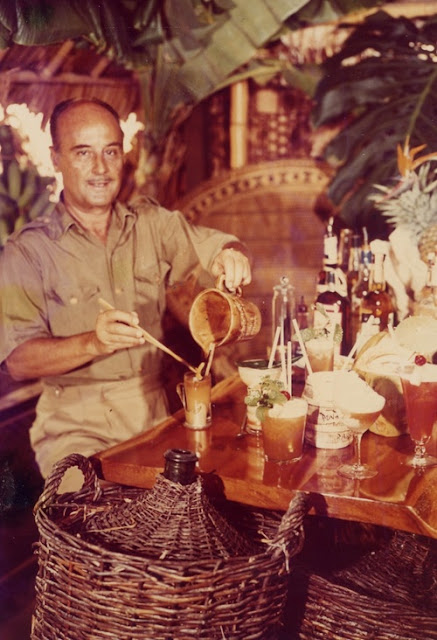
Donn Beach
Don the Beachcomber

The bar was something entirely new. Tropical-themed bars and nightclubs existed, but they were quite elegant and served the same kinds of drinks as everywhere else. Donn's bar was far more rustic and eclectic, designed to look like a beach hut filled with driftwood, fishing gear, and lots of assorted Polynesian artifacts. Donn also created an entirely new kind of drink to be served in this distinctive atmosphere. Working with the base recipe for Planter's Punch, he built cocktails that had "one of sour, two of sweet, three of strong, four of weak." He blended rums and citrus and spices and gave the drinks theatrical names. He also kept the recipes mysterious, using mixtures of ingredients in unmarked bottles so that no one could precisely copy his cocktails.

Don the Beachcomber became incredibly popular. Cate speculates that the Depression was the perfect time for this kind of fantastical, foreign bar experience. It gave people an escape from their troubles and provided a taste of the exotic for those who could not afford to travel. People were enchanted by the entire experience, and no one more so than a fellow named Victor Bergeron.

Trader Vic
Trader Vic

Bergeron owned a small restaurant and bar across from his parents' grocery store in Oakland. He traveled to New Orleans and the Caribbean in hopes of learning to make more exotic cocktails, but it was at Don the Beachcomber that he found his true inspiration. After visiting the bar in 1937, he went home and converted his restaurant into a Polynesian trading post and took the moniker Trader Vic. What Donn Beach had invented, Trader Vic perfected. He served his drinks in fancy mugs with elaborate garnishes. He created tropical cocktails with other spirits besides rum. He even pioneered an entirely new, Americanized twist on Chinese cuisine. The man invented both the Mai Tai and crab rangoon.

As both of these bars grew in popularity and expanded to multiple locations, Tiki exploded. The craze spread across the country, with thatched-roof restaurants filled with Polynesian carvings popping up left and right. But it wouldn't last. By the end of the 1960's, its popularity began to rapidly fade. Cate attributes this to the baby boomers and a growing sense of reality about what was going on in the world. Tiki suddenly seemed inauthentic or even offensive. As bars closed down, their signature recipes were lost. Those establishments that did stick around tried to clumsily reproduce them with the same sugary mixes and synthetic flavors that were popular during that dark age of cocktails. So Tiki got a reputation for being all about tacky decor and bad drinks.

Jeff Beachbum Berry
Jeff "Beachbum" Berry (photo from Liquor.com)

Until recently, that is, when the "Tiki Revivalists" began scouring antique stores for Tiki mugs and piecing together the old recipes in an effort to resurrect the true spirit of Tiki - not just the drinks, but the entire culture of Polynesian Pop that was born alongside them. Modern Tiki legend Jeff "Beachbum" Berry was responsible for rediscovering and distributing many of the classic Tiki cocktail recipes. Slowly but surely, the cocktail world got Tiki fever once again, and it seems like it might be here to stay. You can once again escape to a Polynesian paradise at San Francisco's Smuggler's Cove, Chicago's Three Dots and a Dash, Berry's own Latitude 29 in New Orleans, or countless others across the country. And home bartenders like me can learn to recreate these little pieces of the tropics at home.

So how do you make a Tiki cocktail? While Tiki culture is inspired by Polynesia, the drinks tend to be heavily influenced by Caribbean flavors and liqueurs. As developed by Donn Beach, they usually balance sour (lemon, lime, grapefruit), sweet (syrups, orgeat, grenadine), weak (pineapple juice, seltzer), spirit (traditionally rum), and spice (falernum, allspice liqueur, bitters). In modern Tiki, there has been a lot more experimentation and alteration of this formula, but the general idea is still there.

Jet Pilot

The Jet Pilot is a great starter Tiki cocktail. Invented in the 1950's at the Luau in Beverly Hills (another famous Tiki bar that's worth reading up about), it's a variation on a Zombie. It really shows how complex the flavors in these cocktails can be. Cinnamon, grapefruit, and three different rums offer a deceptively strong and incredibly tasty libation that will instantly transport you into the world of Tiki.

If, like me, you have a limited selection of rums in your home bar, that doesn't mean you can't still make and enjoy these drinks. It's helpful to learn a bit more about rum so that you can decide what the best substitutions will be. I have a little guide here, but I've learned a lot since I wrote it. There's lots of excellent information in Smuggler's Cove, which handily breaks down the rum into categories so you know what the best substitutions are. Other useful guides include this article on Beachbum Berry's six recommended rums and Inu a Kena's Rum 101. For my Jet Pilot, I didn't have a black blended overproof rum, so I subbed in a dark rum. If you're new to Tiki and to rum, it's unlikely that you'll notice too much of a difference!

Jet Pilot

Jet Pilot

1 oz. black blended rum (like Gosling's Black Seal)
3/4 oz. blended aged rum (like Diplomatico Reserva or Appleton Estate Reserve Blend)
3/4 oz. black blended overproof rum (like Lemon Hart 151)
1/2 oz. Velvet Falernum
1/2 oz. lime juice
1/2 oz. grapefruit juice
1/2 oz. cinnamon syrup*
1 dash Herbstura (1:1 Angostura bitters and Herbsaint)

Combine all ingredients in a shaker with crushed ice and a few large cubes. Shake until well chilled and pour into a double Old Fashioned glass or Tiki mug. No garnish is recommended, but feel free to go nuts!

*For cinnamon syrup, combine 1/2 cup water and 2 cinnamon sticks in a saucepan and bring to a simmer. Add 1 cup sugar and stir to dissolve. Remove from heat and let sit for 12 hours. Then strain out the cinnamon sticks.

Recipe adapted from Smuggler's Cove.

Monday, January 2, 2017

Paloma

Paloma

Happy New Year, everybody! I hope you had a fun weekend ringing in 2017. I really like New Year's, because I love the idea that a new year can be a fresh start. Sure most of us will give up on our resolutions by late January, but that's no reason not to try.

The one downside about New Year's is how it falls right after Christmas and marks the end of the holiday season. For me that means leaving good times with friends and family in warm Louisiana and returning to work in cold, snowy Boston. It can be a bit of a bummer. So it's nice to have an evening to toast to hopes and dreams and a better you. It's very motivating (once the hangover subsides).

Paloma

While I was back in Louisiana, I talked a lot about cocktails and the blog with my family. My parents are loyal readers (hi, Mom!) but they lamented the fact that they can't make a lot of the recipes I post here because they're missing ingredients. I believe their exact words were "We don't have any of those weird bitters or anything."

It is a little crazy to see how far the blog has come in this regard. When I started a little over a year and a half ago, St. Germain and Campari were the most exotic things in my bar, and all of my early recipes use very basic ingredients. But as my bar has grown, the cocktails I make have admittedly become a bit more elaborate, and perhaps less accessible. But a great cocktail definitely doesn't need to have exotic liqueurs or unusual bitters - the classics are often the best. And you can always add a dash of something special if you have it.

Paloma

That was my philosophy with the Paloma. This classic cocktail has a very simple recipe: tequila, grapefruit juice, lime juice, simple syrup, and club soda. You can definitely make a Paloma. And if I decided to spice mine up a little with some El Guapo Cucumber and Lavender Bitters, well... that's my prerogative. ;-) It's a nice touch but it's far from necessary.

I really like these bitters (and not just because they're made in New Orleans)! They taste light and fresh. They would work really well in a lot of classic citrusy cocktails: a Gimlet, a Gin & Tonic, even a Martini. El Guapo recommends using them in a Pimm's Cup, which I've definitely got to try. And they're great in this Paloma.

El Guapo Cucumber and Lavender Bitters

The Paloma might not seem like the most appropriate drink for early January, but I actually love reaching for something summery this time of year, just to remind myself that this cold, grey weather isn't permanent. And the Paloma fits the bill perfectly. It's incredibly refreshing - tart, a little bitter, and pleasantly fizzy. You'll wonder why you've never made one before.

Indeed, the Paloma doesn't show up on too many menus in the U.S. We like to drink our Margaritas and pretend we're sipping a little slice of Mexican culture, but in truth the Margarita is far more popular in the States than it is in Mexico. The Paloma, on the other hand, is apparently quite popular south of the border. It's traditionally made with tequila, lime, and grapefruit soda such as Jarritos or Squirt. Lacking that, grapefruit juice, simple syrup, and club soda will do the trick.

Paloma

History: As with many of the real classics, the origins of the Paloma are shrouded in mystery. La Paloma means "the dove," and the cocktail may have been named for a popular folk song of the same name from the 1860's. It's about a man who leaves the woman he loves behind in Havana. The refrain goes:

Si a tu ventana llaga una paloma
Tratala con carino, que es mi persona
Cuentale tus amores bien de mi vida
Coronala de flores, que es cosa mia

Which translates to:

If a dove comes to your window
Treat it with loving care, for it is me.
Tell it your love affairs, my darling,
And crown it with flowers, for it is mine.

There's a tragic link between this song and another cocktail I've featured, the Maximillian Affair. Maximillian Ferdinand, an Austrian, was made Emperor of Mexico following France's invasion of the country in the 1860's. He ruled for only four years before the Mexican people won back their independence and deposed him. Maximillian asked to hear La Paloma before he was executed - possibly because it was a favorite of his beloved wife, Empress Carlota, whom he had sent back to Europe.

The cocktail itself came long after all of this, but no one knows precisely when or where it was invented. It's often speculated that it was created by legendary bartender Don Javier Delgado Corona at La Capilla in the town of Tequila. Don Javier is known for creating the Batanga, a mixture of tequila, lime, and Coca-Cola. Now 93 years old, he is still tending bar at La Capilla and stirring Batangas with the same trusty knife. But recent articles on him make no mention of the Paloma. Another oft-mentioned fact is that the recipe first appeared in print - and was brought to America - in a pamphlet by a bartender named Evan Harrison called "Popular Cocktails of the Rio Grande," but I can't really find much of a source for this, much less a copy of the pamphlet. If anyone has more information on the Paloma's foggy origins, I'd love to hear it!

Paloma

Paloma

2 oz. tequila blanco
2 oz. pink grapefruit juice
1/2 oz. lime juice
1/4-1/2 oz. simple syrup
1 dash Cucumber Lavender bitters (optional)
2 oz. club soda

Prepare a Collins glass or rocks glass by rubbing a wedge of lime or grapefruit on the outside and rolling the glass in salt. Fill the glass with ice. Combine tequila, grapefruit juice, lime juice, simple syrup, and bitters in a shaker with ice. Shake until chilled. Strain into the prepared glass and top with club soda. Garnish with a grapefruit wedge and a sprig of lavender. Sip it while listening to this.

Recipe adapted from Epicurious.

Tuesday, August 9, 2016

BƩsame

BƩsame

Even though I've been blogging for over a year now, I think I still fly largely under the radar - while I've been able to connect with a lot of people through Instagram and Twitter, I don't get a ton of traffic or comments here on the blog. Maybe I should be strategizing a bit more about how to change that, but I didn't really start doing this to make money or create a brand - I just really like doing it. You know how they say "Dance like no one's watching?" Well, I think the internet analog to this is "Blog like everyone's watching." It's been fun with or without an audience.

That said, I do get excited when people notice and contact me, and so I was thrilled when Sukkah Hill Spirits asked if I wanted to taste their two products and try them out in some cocktails. I love trying new spirits and I really liked what their company was doing, so of course I said yes. They sent me a few little bottles of their two liqueurs: the sweet and citrusy Etrog and the spice-flavored Besamim. I'll definitely make something with the Etrog soon, but I wanted to experiment with the Besamim first.

Besamim

The Besamim is like autumn in a bottle. Flavored with vanilla, cloves, cinnamon, and nutmeg, it would be delicious with just some bourbon or rye, or mixed with autumn flavors like maple syrup and apple cider. But it's still summer, and I decided the Besamim was begging to be made into a Tiki cocktail. While cinnamon and cloves probably evoke thoughts of pumpkin pie rather than Mai Tais for most people, ingredients like spiced rum, Allspice Dram, and cinnamon syrup regularly find their way into Tiki drinks, and the Besamim is perfect in this role.

I went with a pretty basic recipe using aged rum, lime and grapefruit juice, some demerara simple syrup, and Angostura bitters. If you can't get your hands on the Besamim (Oh but you can! Order it online or see here for retailers that carry it), Allspice Dram would be a good substitute, though you might have to tweak the recipe a bit to get it just right. You could also try throwing some spices into your demerara syrup for a similar effect.

I decided to call this drink the BƩsame (Spanish for "kiss me") because that's what I kept thinking of every time I read the name of the liqueur. It's tart and tropical, with a beautiful spiced flavor from the Besamim. It's everything I want in a Tiki cocktail, and I think I'll drink it for the rest of the summer.

BƩsame

BƩsame

2 oz. aged rum (I used Barbancourt 4 year)
3/4 oz. Besamim liqueur
1/2 oz. lime juice
1/2 oz. grapefruit juice
1/4 oz. demerara simple syrup*
1 dash Angostura bitters

Combine all ingredients in a shaker with ice. Shake until chilled and strain into a rocks glass filled with crushed ice. Top with more crushed ice and garnish with a mint sprig, a lime wheel, and a cinnamon stick. Mwah!

*Demerara simple syrup is just simple syrup made with demerara sugar, a brown, partially refined cane sugar from Guyana. Combine equal parts of the sugar and water and simmer until the sugar is dissolved. Let the syrup cool before using it. You can substitute regular simple syrup, but it won't be as rich as the demerara.

Tuesday, June 9, 2015

Victoria & Albert

Victoria & Albert

While I was away, I missed the roundup of the May Mixology Monday recipes. Here it is, over at CocktailVirgin. As I predicted, my CuauhtĆ©moc was not the only Mexican-themed Manhattan recipe, though it was the only one that used tequila; Chris at ABarAbove created the rum-based Teotihuacan. Another one I'm looking forward to trying is Rated R Cocktails' Chinatown Moll. Well, to be honest, I'd try them all if I had the ingredients. I hope I have time to come up with something for MXMO XCVII, because I love the idea of working with local ingredients.

Today's recipe is one of my mom's favorite cocktails. My parents live near a location of New Orleans' wonderful Martin Wine Cellar, and periodically come home from tastings or shopping trips with cocktail recipes. My mom made this one and was instantly wowed. And I can see why. It's bright, floral, fragrant, and just the tiniest bit bitter. It's a lovely cocktail.

Victoria & Albert


The original recipe called for only 1 oz. of grapefruit juice, but I felt the drink was too sweet and unbalanced. Increasing it to 1 1/2 really helped, in my opinion. This is also only the second vodka cocktail I've featured on this blog; I already mentioned that I'm not really a big fan of vodka in general. Even as I drank my Victoria & Albert, I couldn't help but wonder what it would taste like with some gin instead.

So, vodka lovers... can you recommend a vodka and/or a cocktail that might change my mind?

Queen Victoria & Prince Albert
Queen Victoria and Prince Albert on their wedding day.

History: This recipe comes from a Square One vodka handout titled "Cocktails for Italian Cuisine," and doesn't appear to exist anywhere else. There's a version of the handout on the Square One website, but it doesn't have the Victoria & Albert on it.

The namesake for the drink is clearly the "it" couple of the 1840's and 50's, Queen Victoria and Prince Albert. They had a very romantic relationship, and Victoria was heartbroken when Albert died of typhoid fever at age 42, after 21 years of marriage. Victoria wore black for the rest of her long life, and she had the servants lay out Albert's clothes for the next day every evening until she died. Their relationship is depicted in the recent movie The Young Victoria, with Emily Blunt as the queen and Rupert Friend as Prince Albert. Perhaps this is a fitting inspiration for a cocktail that is very sweet, with just a touch of bitterness at the end.

Victoria & Albert

2 oz. vodka
1 1/2 oz. grapefruit juice
1/2 oz. Aperol
1/2 oz. simple syrup (or less)
4 basil leaves

Put basil leaves at the bottom of a shaker and muddle until bruised. Add remaining ingredients and ice. Shake until very cold. Double-strain into a coupe glass, and garnish with a grapefruit twist and a basil leaf.

Recipe adapted from Square One Vodka.

Wednesday, April 29, 2015

Hemingway Daiquiri

Hemingway Daiquiri

After making a classic Daiquiri and introducing Luxardo Maraschino Liqueur, a Hemingway Daiquiri was a logical next step. This riff on the traditional Daiquiri was indeed a favorite of Earnest Hemingway, and the addition of grapefruit and maraschino makes it taste quite different from its simpler predecessor. At the proportions below, it would have been a better option for the Luxardo Maraschino Liqueur Bottle Buy post, because the taste of the maraschino is extremely strong. Which isn't a bad thing, if you like it. If you don't, I'd recommend reducing the maraschino to 1/4 oz. and substituting in 1/4 oz. simple syrup if you find the product too sour.

Hemingway in his natural habitat.

History: Renowned author and drinker Earnest Hemingway lends his name to his favorite concoction from El Floridita bar in Havana, Cuba. The story goes that Hemingway flew to Cuba to escape his newfound notoriety and walked into El Floridita when he needed to use the bathroom. He saw the bartender, Constantino Ribalaigua Vert, making daiquiris. Constantino had a special and somewhat theatrical method of chilling the daiquiris so well that they became almost frozen without use of a blender. Hemingway ordered one, and then, like a a truly experienced tippler, asked for one with no sugar and double the rum. Constantino used maraschino liqueur in place of sugar to add some sweetness. (The PDT Cocktail Book claims Hemingway left out the sugar because of his diabetes, but the maraschino likely adds plenty on its own; the more likely explanation is that foregoing the sugar made the cocktails go down easier in bulk, as Hemingway would drink a dozen of these in one sitting.) Made according to the recipe below, the drink is known as a Hemingway Daiquiri; double the proportions, and you have a Papa Doble, Hemingway's preferred beverage.

El Floradita is still operating and serving daiquiris in Havana, and there is a statue of Hemingway at the bar.

Hemingway Daiquiri

2 oz. white rum
3/4 oz. lime juice
1/2 oz. maraschino liqueur
1/2 oz. grapefruit juice

Combine all ingredients in a shaker. Add ice and shake until very cold. Strain into a chilled cocktail glass or coupe and garnish with a lime wheel. Drink at least a dozen of these to become a literary genius.

Recipe from the PDT Cocktail Book.