Quantcast
Garnish
Showing posts with label Orange Bitters. Show all posts

Wednesday, April 24, 2019

Islay and Olive

Islay and Olive, a dirty vodka martini with smoky Scotch

Do you ever look at a cocktail recipe and think, “That’s so weird that it just might be delicious?” That was my reaction to the Islay and Olive when I first saw it in Maggie Hoffman’s book Batch Cocktails. It’s a combination of two of the coolest, classiest drinks you can order – a dirty Martini and an Islay single malt. Both of which I adore. But I never would have thought to combine these already-polarizing liquids in the same cocktail. But it works, and it works wonderfully. The smoke of the Scotch adds a whole new dimension to the savory brine of a dirty vodka martini. Olive oil and a dash of salt turn it into something really special. Admittedly, if you don’t like dirty martinis or smoky Scotch, you will probably not like this drink. But if you like both of them, you must try it. Like immediately.

As with the Principessa di Sole I posted a few weeks ago from the same book, the recipe for the Islay and Olive was printed in batched format, with quantities for 12 servings. I love that Maggie included interesting, spirit-forward drinks like this in the book as well as the usual fruity punches. Although this one isn’t exactly the kind of thing I’d roll up to a party with and expect everyone to love. So I’ve done the math and adjusted the recipe instructions for a single cocktail.

History: This drink was created by Shaun Traxler, a bartender at Vault in Fayetteville, Arkansas.

Islay and Olive, a dirty vodka martini with smoky Scotch

Islay and Olive

1.5 oz. vodka
Scant 1.25 oz. Islay single-malt (such as Laphroaig)
¾ oz. dry vermouth
1 dash orange bitters
1 dash olive brine
1 pinch salt
Olive oil, to garnish.

Combine all ingredients in a mixing glass with ice and stir until chilled. Strain into a coupe. Garnish with a dash of olive oil (I like using my mister for ease and drama), a lemon twist, and several Castelvetrano olives (frozen, if you’d like).

Recipe adapted from Batch Cocktails. I was provided with an advance copy of the book.

Thursday, April 11, 2019

Seville

Seville Cocktail

Instagram has been an amazing source of new recipes for me. I have dozens of drinks bookmarked, and when I'm interested in trying something new, I often browse the list for ideas. That's how I found the Seville. My friends over at Cocktail Detour shared this lovely drink, and it instantly became a part of my repertoire.

The Seville is a variation on the classic Martini. It's still quite dry, but the floral flavor of Lillet Blanc and nutty hints of fino sherry make it a bit sweeter and more delicate. Two dashes of orange bitters and two orange twists (one flamed) lend a hefty dose of citrus. I particularly love this drink with Barr Hill Gin, which is distilled with honey.

Flaming an orange twist

Let's quickly talk about flaming twists! This does not involve actually touching the flame to the peel. Instead, you express the oils of the peel the same way you do with a regular twist, but you do it through a flame, roasting them before they hit the drink. You should see the flame flare up briefly as the oils pass through. This adds a slightly smoky, toasty flavor to the citrus oil and can really change the character of a cocktail. I added a decorative twist afterwards just for fun.

History: The Seville was created by Nick Mautone, who works as a cocktail consultant in New York. (Yes, that's a job, and yes, I want to do it.) He created it for the Michelin-starred restaurant Country (now closed).

Seville Cocktail

Seville

2 oz. gin (Barr Hill recommended)
3/4 oz. Lillet Blanc
2 dashes orange bitters
1/2 oz. fino sherry (to rinse)
2 orange twists

Rinse a coupe with the sherry and express one of the orange twists into it. Combine the remaining ingredients in a mixing glass with ice and stir until chilled. Strain into the prepared glass and flame the second orange twist over the top.

Recipe adapted from Cocktail Detour.

Thursday, October 11, 2018

London Calling

London Calling

Earlier this year, my sister and I went on an epic weekend trip to London. When the immigration the officer asked us what we were planning on doing in the UK, she replied, "A lot of drinking, to be honest with you." And it was true. We did our best to hit all of my bucket-list London bars, including Nightjar and the American Bar at the Savoy Hotel. We also went to Milk & Honey, a Soho branch of the famous New York speakeasy that essentially started the modern craft cocktail movement. It was here that we tried the London Calling.

It was an appropriate cocktail choice for a number of reasons. First, the name, obviously. Second, we had been picking sherry cocktails off of every menu we saw (the Jerezana at Happiness Forgets was another favorite). And third, it was actually invented at the very bar in which we were sitting in 2002, and is the only drink to have stayed on their menu ever since. It's a perfect choice for right now as well, because it's International Sherry Week. Social media has been full of awesome sherry cocktail recipes, and I'm happy to add this new classic to the mix. If you're a sherry newbie, it's a great place to start. There's only a half ounce of Fino (a very dry sherry) in the recipe - just enough to give the drink some complexity and introduce that light, nutty flavor. If you like a Bee's Knees, you'll love a London Calling.

London Calling

History: The London Calling was invented at Milk & Honey in London in 2002 by Chris Jepson.

London Calling

1.5 oz. gin
1/2 oz. fino sherry
1/2 oz. lemon juice
1/2 oz. simple syrup
2 dashes orange bitters

Combine all ingredients in a shaker with ice and shake until chilled. Strain into a coupe and garnish with a grapefruit twist.

Friday, June 15, 2018

Bamboo

Bamboo cocktail

If you like cocktails and you haven't bought a bottle of Amontillado sherry yet, I highly recommend you try it. It's not a big investment nor a big commitment; a decent bottle runs under $20, and because it's a fortified wine like vermouth, it should be stored in the fridge and can eventually go bad. It's a unique ingredient because it has flavors like raisin, nuts, and spice, but is actually fairly dry. So it can add those flavors to a cocktail without adding sweetness. I've made a number of recipes with Amontillado that I absolutely love: the Sherry Cobbler, Teenage Riot, Toffee Negroni, Flor de Jerez, and Legend are a few I've posted, as well as a couple originals of mine: the Pear Tree and L'Orchid. 

Bamboo cocktail

Amontillado sherry plays a starring role in the Bamboo. This is a classic, turn-of-the-century cocktail that was extremely popular in its time. With the resurgence of interest in sherry cocktails, it's finally receiving some attention again. And not a moment too soon. This is a seriously tasty drink, particularly if you love sherry as much as I do. It has a nutty, raisiny flavor while still being surprisingly light. Also, without any hard liquor, the Bamboo is a relatively low ABV cocktail that still drinks like something more spirit-forward. As David Wondrich writes, it "looks like a cocktail, tastes like a cocktail, and punches like a six-year-old."

The first recipe for the Bamboo in print (see below) as well as the more famous version in Boothby's 1908 The World's Drinks and How to Mix Them, don't specify what kind of sherry should be used. As such, you'll see the Bamboo made with a number of different sherries besides Amontillado, as well as with both blanc and dry vermouths. But ever since the Death & Co book changed the way I made Sazeracs, I've trusted them on the classics. When their recipes stray from tradition, it's usually for the better. And I think that's true of their specs for the Bamboo. They use Amontillado sherry and blanc vermouth, which probably tastes more similar to the "French vermouth" of Boothby's day. They also add half a teaspoon of simple syrup, which makes the drink less dry and really helps the sherry shine.

Bamboo cocktail

History: According to Boothby, the Bamboo was invented by Louis Eppinger, a German bartender who worked in Yokohama, Japan, where he managed the Grand Hotel from 1890-1907. Most accounts of the Bamboo's creation claim that Eppinger came up with it while he worked at the Grand, and that the name is a reference to Japan. But the Bamboo pre-dates Eppinger's stint in Yokohama by several years. The recipe appears in the St. Paul Daily Globe in 1886, and by 1893 it appeared on menus in New York as a Boston Bamboo. It was extremely popular, and a pre-bottled version was even sold.

This timeline doesn't mean that Eppinger didn't invent the Bamboo. Before he worked in Japan, he tended bar in San Francisco, and may have invented the drink there, which would explain its gradual journey eastward over the years. But it's clearly an even older drink than most people assume - another little piece of history you can sip on in your own home.

Bamboo

1 1/2 oz. Amontillado sherry (Lustau)
1 1/2 oz. blanc vermouth (Dolin)
1/2 tsp. simple syrup
1 dash Angostura bitters
1 dash orange bitters

Combine all ingredients in a mixing glass with ice and stir until chilled. Strain into a coupe glass. Garnish with a lemon twist.

Recipe from Death & Co: Modern Classic Cocktails.
Historical information from Tuxedo No. 2, Cold Glass, and Imbibe!

Wednesday, February 7, 2018

Martinez

Martinez

I've covered a lot of the really classic cocktails on here, but the Martinez has been a glaring omission. It admittedly hasn't maintained the popularity of some other recipes from the same era - and I'll talk about why that might be - but as the likely ancestor of the modern Martini, it remains an essential drink to know. And it's pretty tasty in its own right.

The reason I haven't made a Martinez until now was because I wanted to make it properly, or at least as close to that as I could come. And that meant I needed a bottle of Old Tom gin. Here's a quick refresher of your gin history: the ancestor of modern-day gin is genever, which originated in Holland. This method of making grain alcohol and flavoring it with herbs like juniper became wildly popular in England during the early 18th century, when there was a heavy tax on alcohol imports and people had to make their own spirits, usually from sub-par grains that weren't good enough for making beer. Flavoring the resulting liquor helped mask this. Hanging a sign with a black cat outside of a drinking establishment was a signal that gin was served there, and so it became known as Old Tom. While less sweet and bready than genever, Old Tom is sweeter and maltier than modern dry gins.

Old Tom made its way to the states and was the gin used in the Tom Collins and other early gin drinks. However, a preference for drier cocktails developed and distilling methods improved, paving the way for classic London Dry gin and causing Old Tom to fall out of favor. But in our modern cocktail renaissance, of course there are distillers producing this classic gin once again. The easiest to find is Hayman's. It's also very affordable - I got my bottle for only $20.

The Martinez is in the same family as a Manhattan or Negroni in taste, but it has a distinct flavor and sweetness provided by the Old Tom and the maraschino liqueur. You certainly could make one with a drier gin, but the inclusion of Old Tom definitely affects the flavor and makes it an exciting link to a past era.

Martinez

History: As I mentioned in my post on the Martini, the history of the Martinez is quite murky. It is often attributed to Jerry Thomas, the "father of American mixology." He worked at the Occidental Hotel in San Francisco, and the story goes that he would mix this cocktail up for commuters catching the ferry to Martinez. But it was not included in the first edition of his Bartender's Guide, and there is no definitive proof that he created the recipe. The first mention of it in print is in O. H. Byron's 1884 Modern Bartender's Guide, three years before the recipe was published in the 1887 edition of Thomas' book. Byron's version is clearly a variation of the Manhattan, which gives us a pretty clear cocktail genealogy of Manhattan > Martinez > Martini.

I should note that there are a half-dozen other versions of the Martinez's origin, from a bartender in the town of Martinez whipping it up to it being a celebratory cocktail for a gold miner who struck it rich. But however the drink came about, it was soon quite popular.

So why didn't this popularity persist? One factor was certainly the decline of Old Tom gin and the preference for drier cocktails, as I mentioned above. It's thought that this turned the Martinez into the Martini. Additionally, a Martinez recipe usually calls for Boker's Bitters, which went out of production in 1906. The recipe was lost for over a century, until a man showed up at the London Bar Show with a small bottle. Dr. Adam Elmegirab studied the tiny sample for 18 months in order to replicate the original recipe. He began selling Boker's Bitters once again in 2009. If you don't have a bottle (like me), a combination of Angostura and orange bitters is a decent substitute.

And finally, there isn't really one definitive recipe for the Martinez. Even Byron's book wasn't clear on exactly how to make one. Byron provides two different recipes for the Manhattan - one with dry vermouth and one with sweet - and then instructs to swap the rye for Old Tom gin to make a Martinez. Both versions persisted, with the drier one experiencing more popularity for a time, but ultimately sweet vermouth won out, perhaps because it was what Jerry Thomas used. Even now, bartenders seem to consider the Martinez a drink that's open to interpretation, with different ratios of gin to vermouth and even additions such as curaçao or absinthe. I found multiple versions of the recipe and tried several to determine what I liked best. The winner is below.

Martinez

2 oz Old Tom gin
1 oz sweet vermouth
1/4 oz maraschino liqueur
2 dashes Boker's bitters
or
2 dashes Angostura bitters
2 dashes orange bitters

Combine all ingredients in a mixing glass with ice and stir until chilled. Strain into a cocktail or coupe glass and garnish with an orange twist and/or a brandied cherry.

Recipe adapted from The Kitchn.
Historical information mostly from Imbibe and Gin Foundry.

Thursday, November 2, 2017

Teenage Riot

Teenage Riot

A couple of weeks after Luke was born, my parents came up to Boston to help us out. We instituted a pretty regular cocktail hour in the evenings - much needed after a day of dealing with a crying baby. My Dad loves Manhattans and Boulevardiers, so I started suggesting some other cocktails for them to try. Before long, a definite theme emerged - we were working our way through all my recipes with gin or whiskey, vermouth, and an amaro. We made Little Italys, Black Manhattans, Negronis, and Montenegronis. The Lucien Gaudin slipped in. I wish there was a general name for this formula, because this combination - specifically with bourbon and sweet vermouth - is definitely my favorite sort of cocktail.

Eventually I thought we ought to switch it up a bit, and I suggested the Teenage Riot. I first heard of this cocktail when the folks at Tipple & Nosh posted their riff on the recipe on Instagram. I didn't have the Cynar 70 and Madeira to make their version, but the original sounded right up my alley - my favorite whiskey/vermouth/amaro combo with some Amontillado sherry and orange bitters to boot.

Sure enough, I loved this drink. It has a beautiful citrus aroma. When you sip, you first get the bite of the rye, then the rich fruity, nutty flavor of the sherry and the Cynar, which stretches into a bitterness at the end. It would be interesting with sweet vermouth, but using dry keeps it lighter and balances things out. It's a beautifully crafted cocktail, and it's going on my list of favorites.

Teenage Riot

History: The Teenage Riot comes from Tonia Guffey of Dram, Flatiron Lounge, and Lani Kai in New York City. She presumably named it after the song by Sonic Youth.

Teenage Riot

1 1/2 oz. rye whiskey
1 1/2 oz. Cynar
1/2 oz. dry vermouth
1/2 oz. Amontillado sherry
2 dashes orange bitters

Combine all ingredients in a mixing glass with ice and stir until chilled. Strain into a coupe and garnish with a lemon twist.

Recipe from Gaz Regan's 2011 Annual Manual for Bartenders via Cocktail Virgin Slut.

Tuesday, July 4, 2017

Mocktail: Fruit Cup

Fruit Cup

When I think of perfect summer cocktails, one of the first things that comes to mind is a Pimm's Cup. (Seriously, look.) This refreshing mixture of Pimm's No. 1, sparkling lemonade or ginger ale, and tons of fresh fruit and herbs is easy to make and perfect for drinking in the heat. It's sort of the sole surviving member of a popular category of cocktails, the fruit cups. While today those two words evoke thoughts of syrupy chunks of pineapple and pear in little plastic tubs, they were once used to describe alcoholic punches made with spirits, spices, and lots of fruit, particularly popular in Britain. Pimm's is essentially a bottled fruit cup mixer, and it has remained popular enough to stand the test of time. But fruit cups can be made with any kind of spirit, and don't have to contain Pimm's at all.

In honor of Wimbledon this week (the #1 excuse to drink a fruit cup - they are to Wimbledon what the Mint Julep is to the Kentucky Derby), Instagrammer and fellow cocktail enthusiast Matt (@theamateurmixologist) has challenged some cocktail Instagrammers to make variations on the classic fruit cup. You can check out their creations by searching the #sippingwimbledon hashtag!

Fruit Cup

While others are sure to get extremely creative with their fruit cups (there was talk of including things like coffee, burnt cinnamon, and Dubonnet), I gave myself a different challenge: to get as close to a classic Pimm's Cup as possible without using Pimm's (or any alcohol, for that matter). This turned out to be an extremely educational exercise. Picking up subtle flavors in liqueurs and spirits can be a challenge, and reconstructing them even moreso. I poured myself a tablespoon of Pimm's for research purposes and got to work.

Fruit Cup

The first thing I notice with Pimm's is the strong scent of bitter citrus, and this carries over into the sip. For this, I thought, a couple of dashes of orange bitters might do, along with some fresh oranges in the cup. Of course, as I've discussed before, bitters do contain alcohol, but they're used in such small amounts that it's not a concern when it comes to most reasons you'd opt for a mocktail (pregnancy, designated driver, etc). Other flavors I get when I sip Pimm's are sweetness, spice, and something a lot like cola, actually. So I brought in some Cocktail & Sons Spiced Demerara Syrup (last seen last week) and a splash of Coke. On the advice of some other non-alcoholic Pimm's Cup recipes, I also added a bit of balsamic vinegar, which somehow seemed to bind all the flavors together.

The result, when combined with the usual ginger ale and a splash of lemon, was surprisingly close to the real thing! Especially once I added the elaborate garnish (cucumber, strawberry, orange, mint, thyme, and rosemary). This is really a perfect mocktail to serve alongside actual Pimm's Cups at your next summer party so that your non-drinking friends don't feel left out. You could even pre-batch the mocktail ingredients so that all you have to do is add ginger ale and lemon, just like you'll be doing for your Pimm's Cups.

Fruit Cup

Since this summer drink is best enjoyed outside, we took our Fruit Cups onto the patio. It was a great excuse to break in* our new GoVino cups - plastic, shatterproof cocktail glasses made for outdoor sipping. They sent me a pack of their whiskey glasses, and they're perfect for drinks on our balcony. Between a slightly wobbly table and an occasionally overzealous little dog at our feet, it's nice to know we're not drinking out of anything breakable!

*In truth, this is the second time we've used the GoVino cups - my husband had some friends up to the balcony for bourbon and cigars after our crawfish boil a few weeks ago, and since they'd already been drinking for much of the day, I thought it prudent to equip them with shatterproof drinking vessels.

Fruit Cup

Fruit Cup

1/2 oz. Cocktail & Sons Spiced Demerara Syrup
1/4 oz. lemon juice
1/4 tsp. balsamic vinegar
2 dashes orange bitters
1 oz. cola
6 oz. ginger ale
Sliced strawberries, oranges, and cucumber
Fresh herbs such as mint, rosemary, and thyme

Combine Demerara syrup, lemon juice, balsamic vinegar, orange bitters, and cola in the bottom of your glass. Swirl or stir briefly to combine. Add a few large ice cubes and top with ginger ale. Give it one more brief stir. Garnish with sliced fruit and herbs - the ones here are just a suggestion, so go nuts!

Monday, April 17, 2017

Whiskey Cocktails with Shaker & Spoon

Mighty Craic Cobbler

Guys, pregnancy kinda sucks. I've been nauseous, exhausted, and uncomfortable. I had a migraine headache that lasted three straight weeks. I haven't wanted to eat anything but bagels and cereal since January. But I want to take a minute to focus on the real martyr here: my poor husband. Because I've been so sick that he has had to make. his. own. cocktails. (Gasp!)

I'm kidding, of course - he's not really suffering, and in fact, he even offered to give up alcohol with me for the duration of the pregnancy. (I told him he didn't have to, and instead encouraged him to drink more so that he would get hungover and feel as sick as me. It's a different sort of solidarity.) But as I certainly haven't been making cocktails for myself the last three months and really haven't felt like making any for him, he has been left to fend for himself. Which usually means nothing more elaborate than a Scotch or bourbon on the rocks. The man can sous vide a steak like nobody's business, but he's a bit helpless with a shaker.

Kiss Me, I'm Whiskey

Enter Shaker & Spoon! When they offered to send me one of their cocktail kits, at first I was disappointed that I would have to turn them down. But then I realized who could really use an easy, pre-packaged craft cocktail complete with instructions: my husband. I asked if they'd be willing to come to his rescue and they came through with their Kiss Me, I'm Whiskey box.

I've heard about Shaker & Spoon for a while, but I've never tried a subscription, mostly because I love making my own ingredients at home already. But I have to admit, it's a really fun thing to get in the mail! I couldn't believe how much they crammed into the box, and how many fresh ingredients were included. The Kiss Me, I'm Whiskey box came with 1 orange, 4 lemons, 4 syrups, three different garnishes (dried peppers, fresh sage, and dried orange wheels, complete with tiny clothespins), and two adorable little bottles of bitters. The only negative thing I could say is that the sage was starting to turn a little brown; everything else looked wonderful.

Pouring Whiskey

Of the three cocktails included in the box, my husband opted first for the Spice of Life, a mixture of Irish Whiskey, sour mix, chipotle-maple syrup, and orange bitters. (I thought he picked it for the spiciness, but he later confessed that it looked the easiest.) The recipe comes from Elle Maeyaert of The Local in Minneapolis. The sour mix is particularly special, her own recipe made from a combination of three different citrus juices and brown sugar. I was surprised by the combination of chipotle and whiskey and looking forward to sneaking a sip of the finished product.

Spice of Life

I'm proud to say that the hubs whipped up this cocktail like a master mixologist. The only advice I gave him was to add more ice when he went to stir it. The kit really made it easy, and allowed him to craft a much higher quality cocktail than he ever would have made on his own. I mean, chipotle maple syrup is a tad advanced even for me.

Spice of Life

The Spice of Life is an incredibly rich and flavorful cocktail. The chipotle maple syrup is an incredible ingredient, and really plays a starring role in the drink. I might have to steal some for other recipes! From my two little sips, I'd say my worries about spice and whiskey playing well together were completely unfounded. My husband loved it and drank it right up. I have I feeling he'll be making another one quite soon.

Spice of Life

Spice of Life

2 oz. Irish Whiskey (we used GrandTen South Boston Irish Whiskey)
1 oz. Elle's house sour*
1 oz. chipotle-maple syrup*
2 dashes orange bitters*

Combine all ingredients in a mixing glass with ice and stir until chilled. Strain into a rocks glass filled with ice. Garnish with a dried chili pepper.

*These ingredients were provided by Shaker & Spoon, but could probably be roughly replicated at home. (Or you can order a box of your own!) For the sour mix, I'd try dissolving 1 cup brown sugar in 1 cup water and then adding 2 cups of citrus juice (maybe 3/4 cup lemon, 3/4 lime, and 1/2 cup orange). For the chipotle-maple syrup, I'd try bringing equal parts maple syrup and water to a simmer, adding several slices dried or fresh chipotle peppers, and letting the whole thing infuse until it's as spicy as you like it.

Mighty Craic Cobbler

Next he reached for the Mighty Craic Cobbler, a cocktail created not far from us at Ruka in Boston. We've actually been wanting to go to Ruka for a while; it was opened by the folks behind Lolita and Yvonne's, two of our favorite spots. But the menu is quite heavy on raw fish, so it's going to have to wait until October at least. Ruka bartender Will Thompson created this simple but delicious orange and apricot flavored cobbler.

Slicing Orange

Since this is a cobbler, the first step was to crush a bunch of ice in our Lewis bag. Then the oranges and syrup are muddled together in the bottom of a shaker. The orange that came in the box was very fresh! The orange-apricot syrup tasted really incredible; it's another ingredient I'd like to steal for other drinks. Next you add some whiskey, shake everything up, and strain it over your freshly-crushed ice. My husband was working like an old pro by now, and whipped this one right up. It was a simple, spirit-forward drink that really let the whiskey shine. Of the two, he preferred the Spice of Life, but he definitely enjoyed them both.

Mighty Craic Cobbler

Mighty Craic Cobbler

2 oz. Irish Whiskey (we used GrandTen South Boston Irish Whiskey)
2 orange slices, 1/4 inch thick
1/2 oz. spiced orange-apricot syrup*

Combine the orange wheels and syrup in the bottom of a shaker and muddle gently (muddling too hard or too long will express the bitterness in the orange rinds). Add the whiskey and fill the shaker with ice. Shake until chilled and strain into a double rocks glass filled with crushed ice. Garnish with a dehydrated orange wheel.

*I'm not entirely sure how best to replicate this excellent syrup. The ingredients listed are water, apricots, demerara sugar, orange zest, allspice, cloves, and citric acid. I would perhaps simmer all of those ingredients together, maybe mashing up the apricots a bit, and then strain the resulting syrup. Do let me know if any of you decide to experiment.
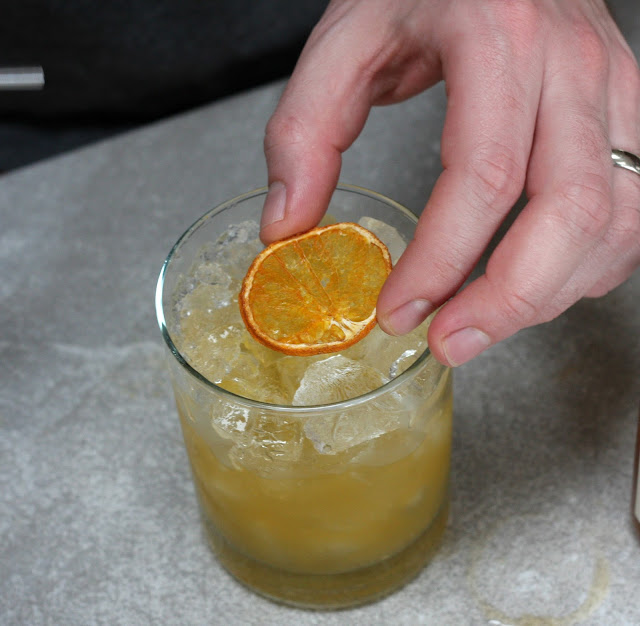
Mighty Craic Cobbler

All in all, we loved the Shaker & Spoon box. There's still one more cocktail in there to try, and plenty of everything left to make more of these two. I still don't think I'll be a regular subscriber myself, but I could definitely see a subscription becoming a go-to gift for friends and family. The other thing these boxes would be great for is a little cocktail party - there's enough in the box to make four of each of the three cocktails, so it would be really fun to have another couple over for dinner and work our way through the recipes. Thanks to Shaker & Spoon for giving us the chance to try it out! My husband is making another Spice of Life as I write this - I think he'll be all set for cocktails for a few days. :-)

Monday, February 13, 2017

Bijou

Bijou

I've got a real classic for you today - the Bijou. It may not show up on a lot of menus these days, but this elegant gin cocktail is over 100 years old. The name, which means "jewel" in French, is a reference to the gemlike hues of the three main ingredients: gin (diamond), sweet vermouth (ruby), and Green Chartreuse (emerald). The traditional recipe for the Bijou is equal parts of these three ingredients, plus a dash of orange bitters.

I eagerly mixed up this equal-parts cocktail, but when I took a sip, I grimaced. The Chartreuse completely dominated the gin and vermouth, making it way too sweet and not at all balanced, at least to my taste. I immediately understood why a lot of modern recipes for the Bijou, like these from Punch and Tuxedo No. 2, tweak the recipe a bit. I tried some variations and decided that this one from Imbibe is my favorite, with more gin, less Chartreuse, and two dashes of bitters. With these proportions, I think the cocktail really takes on the elegant, herbal flavor it's meant to have.

Bijou

History: The first recipe for the Bijou that appeared in print, in C. F. Lawlor's 1895 book The Mixicologist, was a bit different from the version that ended up standing the test of time. Lawlor's recipe is equal parts gin, sweet vermouth, and Grand Marnier, an orange liqueur that probably wouldn't have helped much with the issue of balance and sweetness. Five years later, the equal-parts-plus-orange-bitters version of the recipe appeared in Harry Johnson's Bartenders' Manual. As far as I know, these are our only two clues about the origins of the Bijou.

Bijou

1 1/2 oz. gin
1 oz. sweet vermouth
3/4 oz. Green Chartreuse
2 dashes orange bitters

Combine all ingredients in a mixing glass with ice and stir until chilled. Strain into a cocktail glass and garnish with a brandied cherry and a lemon twist.

Recipe adapted from The New Cocktail Hour via Imbibe.

Monday, February 6, 2017

Devil's Backbone

Devil's Backbone

Before I talk about today's cocktail, some shameless self-promotion: a couple of weeks ago I submitted my Mediterranean Gimlet recipe to Nautical Gin's Gimlet contest, and now voting has begun. Check out all the entries on Nautical Gin's Facebook page and vote for your favorite by giving it a "like." You can find my recipe here - I'd appreciate your votes!

Whenever I'm feeling uninspired or I'm not sure what cocktail to make, I head over to Fred Yarm's blog Cocktail Virgin Slut. It's an incredible database of recipes - Fred posts at least one basically every day - and each one is accompanied by historical details, expert tasting notes, and often good suggestions for substituting the more unusual ingredients. A clickable list of spirits on the side of the page allows you to pick at least one thing you definitely want in your drink, helping to narrow down the vast number of recipes on the blog.

I was using this feature, browsing through the recipes that used amaro, when I came across the Devil's Backbone. It was really too intriguing to pass up. Two bitter liqueurs (Averna and Gran Classico) and a whole half ounce of peaty Scotch promised for a pretty intense cocktail. It seemed right up my alley.

Devil's Backbone

The Devil's Backbone smells intensely smokey with citrusy undertones. It's sweet and citrusy at the beginning of your sip, and then all the bitterness hits you, blending with smoke and peat at the end. It's big and complex and really wonderful - one of the best new cocktails I've made in a while.

If you're lacking some of the ingredients in this recipe, don't despair! You've got some options. For the Scotch, anything with a lot of smoke and peat will do - some examples are Laphroig, Lagavulin, Caol Ila, and Ardbeg. I used Compass Box's Peat Monster, which is a blended Scotch that I got for my peat-crazy husband - it's quite good. You could try subbing Amaro Montenegro or maybe Ramazzotti for the Amaro Averna. And Campari is a decent substitute for the Gran Classico; Fred used Campari when he made this drink.

History: Fred got this recipe from The Complete Cocktail Manual by Lou Bustamante, but it was originally created by Chris Lane at Lolinda in San Francisco. The idea behind the recipe was to use two whiskeys, two amari, and two types of bitters.

Devil's Backbone

1 oz. rye whiskey
1/2 oz. smoky single malt Scotch
3/4 oz. Averna
1/2 oz. Gran Classico
1 dash Angostura bitters
1 dash orange bitters

Combine all ingredients in a mixing glass with ice and stir until chilled. Strain into a coupe and garnish with an orange twist.

Recipe from Cocktail Virgin Slut.

Thursday, December 8, 2016

Hotel Belvedere

Hotel Belvedere

I'm a little late, but I should mention that the roundup for November's Mixology Monday has been posted over at Doc Elliot's Mixology! Check it out for eight brunch-appropriate recipes that will meet all your day-drinking needs. My contribution to the list was the Bombay Sour, which was inspired by my bottle of Black Cloud Saffron Mango bitters. It was the third drink I made with my Black Cloud sampler pack, and today I've got a fourth. Only bottle to go! I found all the flavors in the pack very inspiring, but when I tasted the Charred Cedar bitters, I was really blown away. They've got an incredible woody, smoky flavor that is amazing with bourbon. They make a mean Old Fashioned, but I was looking forward to tailoring a cocktail specifically for these awesome bitters.

Black Cloud Charred Cedar Bitters

I definitely wanted to pair the bitters with bourbon, and I liked the idea of them with Benedictine. This put me in mind of a drink from The PDT Cocktail Book I made almost exactly a year ago called the Hotel D'Alsace, made with Irish whiskey, Benedictine, and Cointreau. I decided to work with the recipe to include the bitters and make it a bit more to my taste, as I found the Hotel D'Alsace a little too sweet. I replaced the Irish whiskey with bourbon and the Cointreau with orange bitters. The result is rich, sweet, herbaceous, and a bit smoky. I made the first one in a Glencairn glass because it was what I had clean and nearby, and I liked the way the shape of the glass brought the smell of the cedar to your nose and forced you to get a good whiff of the rosemary. I decided to keep it in a tulip-shaped glass.

Since this version of the Hotel D'Alsace has charred cedar and burnt rosemary, I started thinking about ruined hotels when it came time to name it. I was reminded of an incredible experience my husband and I had in Croatia when we were traveling after college. We were exploring the Old City of Dubrovnik (now popularized for its role as King's Landing in Game of Thrones). Looking out from the harbor, you can see how the coast curves around slightly to the southeast, forming a small peninsula. On its tip was a big, beautiful building, and we wondered what it might be. Later, we walked a ways up into the hills surrounding the city to get an aerial view of the town and decided to walk there and see what it was.

As we got closer, we realized that while the building had once been beautiful, it was now completely in ruins. We had stumbled upon the ruin of the Hotel Belvedere, a luxurious hotel that was destroyed by the Yugoslav People’s Army on October 3, 1991, during the Siege of Dubrovnik.

Hotel Belvedere
The Hotel Belvedere - you can see why we weren't aware it was in ruins at first. Photo from Untapped Cities.

We wandered around for a while, exploring the hollow buildings and taking photographs. The gutted buildings are covered in graffiti and stained with rust. It was such a sad embodiment of the region as a whole, a real and chilling reminder of the violence that had occurred there not so long ago.

To this day I'm surprised the ruin was so empty, and that we hadn't heard about it before stumbling upon it. It's such a prominent landmark when you look out from Dubrovnik. If you Google it, you can find a few blogs where other travelers describe exploring the ruins, and there are spectacular photos here, here, and here. Part of it was used for the battle between Prince Oberon and the Mountain in Game of Thrones. I was happy to find an article that says the ruin was recently purchased by a Russian billionaire who is going to turn it into a luxury hotel once again. As interesting as the ruins were, they were a monument to a terrible conflict, and I'm glad the region is healing and moving on.

Hotel Belvedere
The Hotel Belvedere's sign in the ruins. Photo from Untapped Cities by Thomas Löbig.

Finding the Hotel Belvedere was one of the more memorable parts of our time in Croatia, and I think it makes a fitting name for this cocktail. Whereas Paris' Hotel D'Alsace is bright and sweet, the Hotel Belvedere is charred and bitter - but still elegant and strong.


Hotel Belvedere

Hotel Belvedere

2 oz. bourbon
1/2 oz. Benedictine
1/2 dropper Black Cloud Charred Cedar Bitters
1 dash orange bitters

Combine all ingredients in a mixing glass with ice and stir until chilled. Strain into a tulip-shaped glass and garnish with a sprig of rosemary. Briefly burn the tip of the rosemary so that it is smoky and fragrant.

Monday, October 10, 2016

Lady Trent

Lady Trent

I’m quite excited to partner with Drizly to bring you today’s cocktail!

If you haven't heard of Drizly, it's an alcohol delivery service. It was started in Boston in 2013 by two Boston College graduates, and today it's available in 18 cities. For a $5 delivery fee, you can have the bottles of your choice delivered to your home within an hour. There's no markup - Drizly partners with local liquor stores and sells everything at their prices. They also sell mixers and ice!

My first encounter with Drizly was earlier this year when my brother, who lives in New Zealand, used it to send my husband a nice bottle of Japanese whiskey for his birthday. It was so convenient - he ordered it online, I got a notification and selected a delivery window, and it showed up at our door the next day. It might have even been the same evening. I was very impressed.


Appleton Signature Blend

When Drizly kindly offered to send me a bottle for this post, I jumped at the chance to order some Appleton Estate Signature Blend Rum (formerly called Appleton Estate V/X). Appleton is one of the most common Jamaican rums you find here in the States. As you may remember, varieties of rum differ from one another largely based on where they're made; each Caribbean island has its own style, largely influenced by whether they were colonized by the English, French, or Spanish. Jamaican rum is English-style. It's distilled in a pot-still and has a distinct flavor that most people refer to as a "funkiness." I'd never really gotten a handle on what on earth this means, so the first thing I did when my bottle arrived was was compare the Appleton to the two other aged rums I had in my bar: Barbancourt 3 Star from Haiti, which is a French-style aged rum made from sugarcane juice, and Folly Cove from Gloucester, MA, made from fermented molasses.

Lady Trent

The Appleton is, well... a bit funkier. It stands up to other ingredients better, holding its own with a rich, fruity flavor. It's also smoother and much more pleasant to drink on its own than the other two. I was pretty excited to use it in a cocktail.

I wanted to do a spirit-forward cocktail that would really feature the Appleton's distinct flavor. I started by playing with a rum version of the Japanese Cocktail, a classic made with Cognac, orgeat, and bitters. (For the uninitiated, orgeat is an almond syrup.) It was pretty good, but when I replaced the orgeat with Velvet Falernum, I felt like I'd stumbled upon something perfect.


Lady Trent

Falernum is a spiced syrup used in many Caribbean cocktails, flavored with ingredients like citrus zest, cloves, allspice, ginger, and almond. Velvet Falernum is an alcoholic version made in Barbados. It's basically a low-proof, sweetened, spiced rum. It did a wonderful job of enhancing the Appleton. Some orange and Angostura bitters rounded out the final product, which is a sort of a rum Old Fashioned. Despite all these big ingredients, it has a surprisingly delicate, almost floral flavor, which I decided to emphasize with a slender coupe and an orchid garnish.


Lady Trent

I named my new cocktail the Lady Trent after the main character in a wonderful series of books I've been reading by Marie Brennan. It seemed to fit - the drink is strong, exotic, and elegant.

The Appleton Estate is available from Drizly here!


Lady Trent

Lady Trent

2 oz. aged Jamaican rum (Appleton Signature Blend recommended)
1/2 oz. Velvet Falernum
1 dash Angostura bitters
1 dash orange bitters

Combine all ingredients in a mixing glass with ice and stir until chilled. Strain into a coupe and garnish with an edible flower.

Thanks to Drizly for making this post possible!

Wednesday, August 17, 2016

Bottle Buy: Yellow Chartreuse

Yellow Chartreuse

Until I posted about Crème de Cacao a couple of weeks ago, I hadn't done a Bottle Buy post in quite a while. That was, quite simply, because I hadn't bought any new bottles. There's so much you can do with just a few spirits and liqueurs that I could probably never run out of drinks to make with what I've introduced so far. But there were still a few things on my wish list, and I finally went ahead and bought them. The first one I'll talk about is Yellow Chartreuse.

Yellow Chartreuse is the younger sibling of Green Chartreuse, which is probably the more popular of the two. Like Green Chartreuse, Yellow Chartreuse it is made by Catholic Carthusian monks in the Order of St. Bruno, also known as the Chartreuse Order. The Order has operated in the Chartreuse Mountains of France since 1084. In 1737 they made the excellent decision to start making booze. Their Green Chartreuse was initially sold to local villages as a health tonic, but people enjoyed drinking it for fun, so they reduced its alcohol content a bit and began selling it as a liquor. One hundred and one years later, they introduced Yellow Chartreuse.

Despite the fact that it hasn't been around as long, Yellow Chartreuse seems to appear in more classic cocktails than Green. Its yellow color comes from the addition of saffron. It's lighter and sweeter than Green Chartreuse, and also has a lower alcohol content (40% as opposed to 55%). Unfortunately it's only slightly cheaper - these are pricey liqueurs.

So, being a generally frugal cocktail blogger, I wondered: could you buy just one or the other, and use them interchangeably? And, if so, which one should you buy? In my mind, Yellow Chartreuse seems more versatile. It mixes well with anything - gin, whiskey, tequila, vodka, whatever. Whereas I feel a bit more squeamish about mixing Green Chartreuse with whiskey. I'm not sure why... maybe it's just the color? It doesn't seem right. But I wanted to know if there was any basis to my qualms. So I made two cocktails - the Last Word, which is usually made with Green Chartreuse, and the Greenpoint (recipe below), which is usually made with Yellow - following the original recipes, and then swapping the Chartreuses.

The short result is that neither cocktail seemed right with the other Chartreuse. The Last Word with Yellow Chartreuse tastes like a faint echo of the original cocktail. The flavors are there, but muted. It's too sweet and not complex enough. If you only had Yellow Chartreuse, you could make yourself a Last Word and get an idea of what the cocktail tastes like, but it wouldn't be the real thing. The Greenpoint with Green Chartreuse is a much better drink than I expected, but I don't feel like the flavors mesh as well. The Green Chartreuse is too overpowering. So I'm afraid you can't really get away with interchanging these two liqueurs. If you can only buy one, personally I'd still spring for Green first, because the Last Word is one of my all-time favorite cocktails, and I love the more intense flavor.

Yellow Chartreuse

Price: $50-60
Alcohol Content: 40%
Popular Cocktails: Greenpoint, Diamondback, Alaska, Widow's Kiss

The first cocktail I made with my Yellow Chartreuse was a Greenpoint. This is a variation on the Brooklyn cocktail, which is sort of a variation on the Manhattan (see more on this below). While Yellow Chartreuse doesn't exactly have a starring role in the Greenpoint, it's probably one of the best-known cocktails that makes use of it, and comparing the flavor to a traditional Manhattan will definitely help you see how the Chartreuse is working in the recipe. It makes the drink more sweet and herbal than a Manhattan, and the lemon twist and orange bitters provide a lovely hint of citrus.

Greenpoint

History: The Greenpoint was created in 2005 by Michael McIlroy at Milk & Honey in New York. But its history really goes back quite a bit farther.

In the early twentieth century, there were five popular cocktails named after New York City's five boroughs: the Manhattan (rye, sweet vermouth, bitters), the Bronx (rye, sweet vermouth, dry vermouth, orange juice), the Brooklyn (rye, dry vermouth, maraschino liqueur, Amer Picon or bitters), the Queens (gin, dry vermouth, sweet vermouth, pineapple juice), and the Staten Island Ferry (rum, pineapple juice). For whatever reason, the Manhattan persisted in popularity and was elevated to classic cocktail status, while the other four fell somewhat into obscurity. As interest in pre-Prohibition cocktails was revived, so were these old recipes. The Brooklyn in particular has enjoyed a resurgence in popularity, and bartenders began playing with the recipe and naming their new creations after Brooklyn neighborhoods: Slope, Prospect Park, Carroll Gardens, Cobble Hill, Bensonhurst, Red Hook. And, of course, Greenpoint.

For more on these Brooklyn-themed cocktails, check out this article from Punch.

Greenpoint

2 oz. rye whiskey
1/2 oz. Yellow Chartreuse
1/2 oz. sweet vermouth
1 dash Angostura bitters
1 dash orange bitters

Combine all ingredients in a mixing glass with ice and stir until chilled. Strain into a cocktail glass or coupe. Garnish with a lemon twist.

Recipe from Liquor.com.

Friday, July 29, 2016

Fancy Free

Fancy Free

I think most people would agree that the Old Fashioned is just a really good cocktail. It's simple, classic, and delicious. And because it's so simple and so good, there are a lot of variations out there. Some stay pretty close to the source material, like I did with my Autumn Cranberry Old Fashioned. Others go a bit farther afield with additional ingredients, like my Blood and Smoke or the Ward Eight, or new base spirits as in the Oaxaca Old Fashioned (tequila and mezcal) and the Gin-Campari Old Fashioned (gin and... you guessed it). Spirits, bitters, and sugar... it's a fun and easy combination to play around with.

In my favorite Old Fashioned recipe, I like to add a little liqueur from the jar of Luxardo cherries. So the Fancy Free seemed like a brilliant idea - it replaces simple syrup and/or cherry juice with Luxardo maraschino liqueur. Orange and Angostura bitters round it out. The recipe calls for bourbon, but I think it might be better suited for rye. It depends how you prefer your Old Fashioneds.

This cocktail is sweet and rich, with a lingering spice and bitterness. It doesn't stray too far from its inspiration - a wonderful, complex riff on a classic cocktail.

History: When I posted this, I incorrectly stated that this cocktail was a recent invention, but it turns out it's quite old! Which isn't too surprising, given its ingredients and simplicity. The recipe appears in Crosby Gaige's Cocktail Guide and Ladies' Companion from 1941. I found one blog that claims this is its first time in print.

I'd never heard of Crosby Gaige before, so I looked him up. Turns out he was a pretty interesting guy. Born in 1883, he was the son of a postmaster from Nelson, NY. He worked his way up to become a wealthy Broadway producer and publisher. His small publishing company attracted the likes of Virginia Woolf and James Joyce. He lost all his money and then earned it all back again. He he was quite the foodie and a huge fan of cocktails. "In the world of potables the cocktail represents adventure and experiment," he wrote. I entirely agree.

But where did Gaige get the recipe for the Fancy Free? Apparently he had a huge collection of recipe books, so it might have come from somewhere else. If any of you cocktail history buffs have additional information, I'd love to hear it.

Most of my info on Crosby Gaige came from this article and a Wall Street Journal article by Eric Felten called "Easier Does It: Starter Cocktails."

Fancy Free

2 oz. bourbon
1/2 oz. maraschino liqueur
2 dashes orange bitters
1 dash Angostura bitters

Combine all ingredients in an Old Fashioned glass with a large ice cube. Stir to combine. Garnish with a large orange twist and a brandied cherry.

Recipe from Serious Eats.