Quantcast
Garnish
Showing posts with label Ginger Beer. Show all posts

Thursday, December 20, 2018

Spiced Pear Mule

Spiced Pear Mule

What are you doing for Christmas? We usually go home to Louisiana for the holidays, but this year we're going a bit farther - to New Zealand! My brother moved to Auckland a couple of years ago and we're finally going to visit. My first summertime Christmas! I'm so excited. Except for the part where we have to take a 15-hour flight with a 15-month-old. I don't think that part is going to be fun. Air New Zealand serves alcohol, right?

Spiced Pear Mule

I've got one more holiday cocktail for you before I sign off for Christmas, and it's a really wonderful one: a Spiced Pear Mule made with Barritt's Ginger Beer. Barritt's is a brand from Bermuda that has been around since 1874! It's a super tasty ginger beer that is perfect for mules. I'm sure you're familiar with the Moscow Mule, but did you know that the mule is a whole category of drinks? A mule, also called a buck, is made of liquor, citrus juice, and ginger beer. There's no need to stick to vodka. It's delicious with bourbon, gin, or - possibly my new personal favorite - Cognac.

Spiced Pear Mule

Cognac (or brandy) pairs really well with ginger so it's a natural choice with ginger beer. It also goes wonderfully with pear. So I couldn't help but reach again for St. George Spiced Pear Liqueur to make this delicious mule more festive. If you don't have a bottle of the liqueur, you can still make this cocktail with 1 ounce of pear juice or pear brandy. Try making or buying some spiced Demerara syrup and you won't be missing out at all!

Spiced Pear Mule

Spiced Pear Mule

1 1/2 oz. Cognac or brandy
1 oz. St. George Spiced Pear Liqueur
3/4 oz. lime juice
1/2 oz. Demerara simple syrup
Barritt's Ginger Beer, to top

Combine Cognac, pear liqueur, lime juice, and syrup in a shaker with ice and shake until chilled. Strain into a copper mug filled with ice. Top with ginger beer. Garnish with pear slices and a cinnamon stick and enjoy!

This post was sponsored by Barritt's Ginger Beer. All opinions are my own.

Wednesday, June 27, 2018

Pimm's Slushie

Pimm's Slushie

Something about the summertime seems to bring out the kid in all of us. Great weather, time outdoors, vacations... it's easy to forget that we were complaining about shoveling snow three or four months ago. Even the cocktails are more fun. Summer drinks are so bright and playful - creative garnishes, colorful fruits, lots of fizz, and the occasional frozen cocktail. From boozy popsicles to frosé, it's clear that frozen booze is in. And why not? It's so much fun. And totally weather-appropriate.

Pimm's Slushie

There are lots of ways you can turn your favorite drink into an icy treat. Breaking out the blender works great if you want a smoother texture. But if you have a little time to wait and want something a little icier and more fun, you can make a slushie. Since alcohol doesn't freeze, diluting a cocktail a bit and leaving it in the freezer overnight can produce a perfect, partially-frozen treat. All you need to do is break it up a little with a spoon and enjoy.

Pimm's Slushie

For my first boozy slushie, I wanted to make one of my favorite summer cocktails: a Pimm's Cup. Made with Pimm's No. 1, ginger beer, lemon, cucumber, and lots of fruits and berries, it's a fantastic summer treat. But turn it into a slushie and you have utter warm weather perfection. Serve it with a spoon and a dash of fizzy ginger beer on top for a little extra bite. You'll feel like a kid again in no time.

Pimm's Slushie


Pimm's Slushie


Pimm's Slushie

3 oz. Pimm's No. 1
3 oz. ginger beer (+ more to top)
1 oz. water
3/4 oz. lemon juice
1/4 oz. cucumber juice*
1/8 oz. simple syrup

Combine all ingredients in a freezer-safe glass or tupperware and stir gently. Leave in freezer until frozen, roughly overnight. Use a spoon to break up the slushie and transfer to a stemmed glass. Garnish with frozen berries and a sprig of mint. Serve with more ginger beer on top.

*If you don't have a juicer, the best way to get cucumber juice is to grate a cucumber into a fine mesh strainer over a bowl or cup measure. Press the gratings to extract the liquid.

Thanks to Kitchen Treaty for some advice on slushie-fying a cocktail.

Friday, April 14, 2017

Mocktail: Wishful Thinking

Wishful Thinking

Thanks so much to all of you who shared congratulations and good wishes after my announcement on Tuesday! It's so much more fun now that everyone knows about the pregnancy. I promise I won't overload the blog with baby-related things, but I am looking forward to sharing the next few months with all of you.

Not being able to drink hasn't been nearly so bad as I thought. I was mostly worried that it would be a bummer when I went out, especially to bars. Ever since we started trying for a baby, I've been scanning menus for mocktail sections for future reference. I've been happy to see that most places will have two or three on the menu, or at least a nice selection of sodas and juices. The selection isn't as varied as if you could order a cocktail or a beer, but it's nice not to be left out.

Wishful Thinking

One place that reliably has a couple of high-quality mocktails on their menu is Backbar in Somerville. This is probably my favorite place to grab a cocktail in the Boston area, so I was particularly miffed at having to choose between the two non-alcoholic options. But I really enjoyed the mocktail I ordered, which was made with club soda and a lavender-lime-cardamom shrub. I liked the flavors together, and decided to work on a variation on this for my first mocktail recipe. For ease, I skipped the shrub and made a quick lavender syrup that I paired with lime juice and cardamom bitters. I also worked in some ginger beer for extra flavor. The final product is so delicious, you won't mind in the least that there's no booze involved!

A note on this being a "mocktail:" bitters are generally made with alcohol, so if you're avoiding any traces of it, you'll want to use a substitute (in this case, I recommend throwing some cardamom pods into the syrup as well). But since they're used in such tiny quantities, the fact that they're technically alcoholic isn't going to be an issue during pregnancy or if you're the evening's designated driver.

Wishful Thinking

Booze it up: If you want to make this a cocktail, I'd try adding some vodka, gin, or white rum.

Styling: Copper straw from Viski, glass from World Market.

Wishful Thinking

1 oz. lime juice
3/4 oz. lavender syrup*
1 dash cardamom bitters (Scrappy's)
6 oz. ginger beer (I recommend a mild one for this recipe)

Combine lime juice, lavender syrup, and bitters in a shaker. Add ice and shake until chilled. Strain into a Collins glass and add ice. Top with the ginger beer and stir gently. Garnish with a lime wheel and some dried or fresh lavender.

*For the lavender syrup, combine 1/3 cup sugar, 1/3 cup water, and 4 sprigs of dried lavender in a saucepan (fresh lavender would be even better). Bring to a simmer, stirring to dissolve the sugar. Turn off the heat, cover, and let the syrup sit for one hour. Fine strain to remove the lavender, and let cool before using.

Tuesday, September 8, 2015

Bufala Negra

Bufala Negra

I've had this cocktail bookmarked for a long time. It just sounded so unusual: bourbon, basil, balsamic vinegar, and ginger beer. The flavor is incredibly interesting. Unlike the Strawberry Balsamic Smash, where a mere hint of balsamic vinegar enhanced the other flavors of the cocktail, the Bufala Negra is all about the balsamic. After I took my first sip, I wasn't sure I liked it. Then I took another, and another. As my palate slowly got used to the flavor, I enjoyed it more and more. When you roll it around on your tongue, you can pull out the savory notes of basil and balsamic.

The recipe specifies good aged balsamic vinegar, and I'd abide by that. In my experience the cheaper ones tend to taste more acidic, where as more expensive ones are sweeter and more flavorful. It could make all the difference in this cocktail. Plus, balsamic vinegar keeps forever and isn't something you use large quantities of, so it seems like a worthy splurge.

History: The original Bufala Negra was invented by Jerry Slater of H. Harper Station in Atlanta. His recipe uses a balsamic syrup instead of straight vinegar. John Greco of Philip Marie in Greenwich Village created this adaptation. As far as the name, I believe it means "black buffalo" in Portuguese.

Bufala Negra

1 1/2 oz. bourbon
1/2 tsp. simple syrup
1 tsp. balsamic vinegar
4 basil leaves
2 oz. ginger beer

Muddle basil with simple syrup in the bottom of a shaker. Add bourbon and shake with ice until chilled. Strain into a rocks glass filled with ice. Top with ginger beer. Using a teaspoon, gently drizzle balsamic on top (most of it will sink). Garnish with a sprig of basil. Be sure to stir before you sip.

Recipe adapted from the New York Times.

Thursday, September 3, 2015

Moscow Mule

Moscow Mule

I always thought the Moscow Mule was a below-average cocktail. I've already mentioned that I'm not really a fan of vodka, and mixing it with ginger beer basically just tastes like... ginger beer. The mere invention of the Moscow Mule was nothing more than a marketing trick to get people to buy vodka and ginger beer. (Seriously. Read on.) What makes this cocktail any better than a rum & Coke or bourbon & ginger? Does it really deserve its own fancy mug? And are you really going to make them often enough to justify buying a set?

Well, I'm not going to write off a cocktail until I've made it myself. Copper mug and all.

Moscow Mule

I was heartened when I found a recipe for the Moscow Mule in the PDT Cocktail Book. Not only did its inclusion in such a respected publication bring it up a few notches in my estimation, but the recipe was a little more involved than the vodka + ginger beer + wedge of lime I'd imagined. It uses lime juice, simple syrup, and a fairly low ratio of ginger beer to everything else. In fact, I thought it was too low and ended up adding more.

The finished product is not bad. I knew it would be tasty, but it's also more sophisticated than I expected. I'll always prefer spirits with more flavor, but I can appreciate the Moscow Mule as a decent vodka cocktail. It would be a great option for guests in the summer time.

And how did I, the Moscow Mule skeptic, end up with two copper mugs? They were a free gift from Redfin after we bought our condo, and if I turned them around you'd see the logo emblazoned on the back. I'm all about the free stuff.

Oh, and full disclosure: I had to double the recipe to fill them.


Moscow Mule

History: It was 1941, and Jack Morgan, the owner of the Cock 'n Bull Restaurant in Hollywood, had a problem. He had recently started making his own brand of ginger beer, and no one was buying it. He shared his woes over a drink with two friends, John Martin and Rudolph Kunett, who worked for G. F. Heublein Brothers. They knew how he felt. Their company had recently started importing a Russian spirit called vodka, and the public wasn't interested in drinking it. They suddenly realized the solution to both of their problems. What if they mixed the vodka and the ginger beer together and started serving it as a signature cocktail? They tried it right then and there, and were pleased with the results. They named the cocktail the Moscow Mule, Moscow for Russia, and Mule for... well, no one is really sure. The cocktail is technically a type of Buck. It may have been called a Mule because of its "kick."

Martin traveled the country popularizing the drink, always in a copper mug so that everyone would know it was a Moscow Mule even in photographs. Why the copper mug? Well, apparently a Russian immigrant named Sophie Berezinski had designed the now-famous copper mug in her father's shop back in Russia, and had come to the US with about 2,000 of them to sell. Only - you guessed it - no one wanted them. Martin clearly saw the commercial advantage of serving the Mule in signature mug. He made ads with celebrities drinking out them, and Morgan engraved the names of his celebrity patrons on mugs that he hung behind the bar at the Cock 'n Bull. The cocktail's popularity soared, as did that of its main ingredient, vodka.

Smirnoff ads from the 1960's featuring Woody Allen, Monique Van Vooren, and the Moscow Mule.

In a way, this is a disappointing origin story for a cocktail. It was entirely a commercial endeavor, invented to sell products, orchestrated right down to its serveware. But on the other hand, it's kind of a great story. You can just picture the lightbulb going off in these guys' heads as they realize what to do.

And, if I'm being honest, it's really not a bad cocktail.

Moscow Mule

1 1/2 oz. vodka
3/4 oz. lime juice
3/4 oz. simple syrup
2 oz. ginger beer

Combine vodka, lime juice, and simple syrup in a shaker. Add ice and shake until chilled. Strain into a copper mug filled with ice. Top with ginger beer and stir gently. Garnish with a couple of lime wedges.

Recipe adapted from The PDT Cocktail Book.

Friday, August 28, 2015

Boston Tea Party

Boston Tea Party

The roundup post for Mixology Monday 100 is up! This month's theme was a tribute to Paul Clarke of The Cocktail Chronicles, centered around simplicity, elegance, and timelessness. As a result, it's a fantastic list of recipes, and best of all, they're very accessible - I've got the ingredients to make most of them already. Check it out!

My own Mixology Monday submission was the Old Cuban, an existing recipe that I really like. But today I do have an original cocktail that I think is pretty darn good. The idea for it came from one served at Miel in Boston's Intercontinental hotel. It's a really lovely French restaurant right on the Fort Point Channel, but for some reason it seems to be perpetually empty. This was good news for us a couple of years ago when we were trying to make a reservation for a large group during graduation season in Boston - good luck finding a table in May and June. But Miel turned out to be positively lovely, and they served one cocktail using tea-infused vodka that I really liked and wanted to replicate at home. Thus the Boston Tea Party was born.

Boston Tea Party

As I've said before, I'm not big into vodka because I find it pretty tasteless, but that exactly quality makes it a great spirit to use for infusions. I haven't tried very many yet, but this tea-infused vodka is easy and really good. Just leave a teabag in some vodka for a while. How long depends on how much vodka and how strong you want the flavor. I infused about a cup of vodka yesterday, and left the teabag in for roughly six hours. I've done it overnight as well. I always use decaf tea since I'll probably want to be drinking this in the evening.

With tea-infused vodka, honey simple syrup, lemon juice, and a splash of ginger ale or ginger beer, this cocktail tastes exactly like sweet tea. Drinking it reminded me of the big batches of the stuff my grandmother used to make and store in jars in the fridge. It's crazy how dead-on the flavor is. It's an incredibly refreshing cocktail, perfect for the end of summer.

Boston Tea Party

Boston Tea Party

2 oz. tea-infused vodka*
3/4 oz. lemon juice
3/4 oz. honey simple syrup**
1 oz. ginger ale or ginger beer

Combine infused vodka, lemon juice, and honey simple syrup in a shaker. Add ice and shake until chilled. Strain into a rocks glass filled with ice and top with ginger ale or ginger beer (lemon-lime soda works nicely too). Garnish with a lemon wheel.

*For tea-infused vodka: pour desired amount of vodka into a cup measure or glass. Add a teabag. Let sit until dark brown in color, four hours to overnight.

**For honey simple syrup: combine equal parts honey and water in a saucepan. Bring to a low simmer and stir until honey is dissolved. Let cool before using.


Thursday, August 13, 2015

French Maid

French Maid

I've been on a ginger beer kick lately. One ginger beer cocktail tends to lead to another, especially when you buy it in a large bottle or six-pack. Loathe to let a mixer go to waste, I was flipping through The PDT Cocktail Book and came across the French Maid. I was a bit skeptical about mixing my nice Cognac with a can of Goslings, but I'm glad I did. Herbal and sweet with a hint of spice, this cocktail is delicious and incredibly refreshing. There's something beautiful about the way the flavors work together. I think you need the Cognac to really make it perfect. You could certainly use whiskey or rum and probably still make a darn good drink, but it wouldn't have the delicate sophistication of the French Maid.

I think this is the first cocktail I've written about that uses Velvet Falernum (pronounced fah-LEHR-num, if you were wondering). This is a spiced syrup that is most often used in Caribbean-style cocktails and tiki drinks. It has flavors of almond, citrus, cloves, and other spices. The taste is fairly subtle, especially when mixed with other ingredients, but it really adds an extra depth of flavor to a cocktail. Interestingly, you can buy alcoholic or non-alcoholic versions. The non-alcoholic sort is basically a flavored syrup. Fee Brothers makes one that should be pretty easy to find. But the variety I see used most often is John D. Taylor's Velvet Falernum. It's basically a very low-proof rum infused with sugar and spices, made in Barbados.

French Maid

History: Jim Meehan created this cocktail in 2008. It's based on the Kentucky Maid, which uses bourbon and foregoes the Falernum.

French Maid

1.5 oz. Cognac
3/4 oz. lime juice
1/2 oz. simple syrup
1/4 oz. Velvet Falernum
1 oz. ginger beer
4 cucumber slices, 1 reserved for garnish
4-6 mint leaves, plus a sprig for garnish

Muddle cucumber, mint, and simple syrup in the bottom of a shaker. Add Cognac, lime juice, Velvet Falernum, and ice. Shake until chilled. Strain into a rocks glass filled with ice. Top with ginger beer and stir gently. Garnish with a cucumber slice and a sprig of mint.

Recipe adapted from The PDT Cocktail Book.

Monday, August 10, 2015

Bottle Buy: Pimm's No. 1

Pimm's No. 1

Pimm's No. 1 is a very British liqueur. I think I first learned of it from a friend who spent time in London, and everyone I've met since who has been there fondly considers Pimm's a cultural mainstay of the UK. By the time I visited myself, it wasn't all that surprising to see it on menus, because these days it's not hard to find a Pimm's Cup in American bars.

Pimm's is a gin-based liqueur infused with botanicals and spices, and it has a long history. Its inventor was James Tee Pimm, a theologist-turned-shellfish-monger who opened an oyster bar in London in 1823. He quickly became a successful restauranteur. He invented Pimm's as a health tonic and/or a cocktail to accompany his oysters - I've heard both. It was a huge success, and Pimm began bottling and selling it all over the British Empire. He expanded from there, creating the No. 2 Cup (a Scotch base), the No. 3 Cup (a brandy base), and so on up all the way to No. 6 (vodka). Only No. 1 survives, though Pimm's has released versions of the others as special seasonal bottles.

Pimm's will admittedly not be the most versatile thing on your bar, but it's a fun ingredient to experiment with. It does pop up in craft cocktail recipes every now and then. It's the main ingredient in one of my favorite cocktails, the Battle of Trafalgar, which I'll share the recipe for soon.

Pimm's No. 1

Price: $25
Alcohol content: 25%
Popular cocktails: Pimm's Cup

Pimm's Cup

The Pimm's Cup is the quintissential Pimm's cocktail, and there are many variations.  In England, it's made with sparkling lemonade, which is not very common in the United States, so here it's often made with ginger ale or lemon-lime soda. Often those are the only two ingredients, and it may be garnished with just a single cucumber wheel. But the true British version includes cucumber and a variety of fresh fruits. The Pimm's website recommends mint, orange, strawberries, and cucumber. I usually like to follow the most original and authentic recipe, but when I saw this one on Bon Appetit I couldn't pass it up. If nothing else, it was an excuse to use not one, not two, but three of the herbs from my patio garden, and ginger beer seems like a fine alternative for sparkling lemonade. If you're lacking one or two ingredients, it's ok - it is an awful lot of stuff - but the scent of the herbs as you take each sip is what elevates the flavor of this cocktail. It's an amazingly refreshing summer drink, and a particularly good cocktail for guests before a barbecue or dinner outdoors.

Pimm's Cup

History: So far, I can't really separate the origin of the Pimm's Cup cocktail from the origin of Pimm's itself. Did James Tee Pimm serve his liqueur with sparkling lemonade and fruit? Or did that come about later on? I'll keep trying to figure it out. But the liqueur itself is inextricably associated with this one cocktail. Even the names are difficult to tell apart.

The Pimm's Cup is the iconic drink for summer sporting events in England, including Wimbledon and the Henley Royal Regatta. It has also, somewhat surprisingly, become associated with New Orleans, and particularly the Napoleon House bar. Sometime in the 1940's, its proprietor decided that the Pimm's Cup would be an excellent cocktail to serve in the southern heat. And he was right.

Pimm's Cup

Pimm's Cup

3 1/2 inch slices cucumber
3 oz. Pimm's No. 1
1 1/2 tbsp. lemon juice
1/4 tsp. simple syrup
3-4 oz. ginger beer
1 sprig mint
1 sprig thyme
1 sprig rosemary
1 lemon slice
1 cucumber spear
2 strawberries, halved

Muddle cucumbers in a shaker. Add Pimm's, lemon juice, and simple syrup. Fill shaker with ice and shake until chilled. Strain into a Pilsner glass filled with ice. Fill glass with ginger beer and stir gently. Push lemon, strawberries, cucumber, and herbs into glass. Cheers.

Recipe adapted from Bon Appetit.

Friday, June 12, 2015

Mixology Monday: Boston Molassacre

Boston Molassacre

Mixology MondayThe theme of this month's Mixology Monday, hosted by PuntneyFarm, is Hometown Hooch. The idea is to use locally-distilled spirits. And, being in Boston, I'm in luck. There are distilleries popping up in the Boston area left and right. I chose to use Folly Cove rum from Ryan & Wood in Gloucester, MA, but there were tons of other options, including Bully Boy, Berkshire Mountain, GrandTen, and the new Boston Harbor Distillery, just to name a few.

The current resurgence in local distilleries harkens back to the early days of booze production in the States, when most spirits were made and sold locally. However, Boston had a further reach than most. Its first distillery opened in 1667, and by the American Revolution, gallons of molasses were being imported from the Caribbean every year for Bostons 50+ distilleries to make rum. Rum was the most popular spirit of the time, and Massachusetts was America's leading exporter. But in the 1800's, importing sugar and molasses became more difficult, so most of America turned to whiskey made from home-grown grains. The number of rum distilleries steadily decreased.

The final nail in the casket of Boston's distilling industry was in 1919. Purity Distilling Company was operating at 529 Commercial Street in Boston's North End, right at the mouth of the Charles River. They were still in the business of distilling molasses, but not to make rum; during World War I they used it to make explosives, and in 1919 they were mostly producing industrial ethanol. At center of the distillery was an immense tank for storing and fermenting molasses. We're talking 58 feet high and 90 feet in diameter, containing something like 2.3 million gallons of the stuff. And it wasn't in the best shape. It leaked so regularly that residents of the North End would go collect the molasses dripping off of it.

It was just after noon on January 15, 1919. It was an unseasonably warm day in Boston, which may have had something to do with what happened next.

The tank burst. Its steel plates flew apart, shooting rivets like bullets. A huge wave of warm molasses swept over the North End at 35 miles per hour, leveling buildings, sweeping away cars, and destroying the elevated subway tracks leading to North Station. Twenty-one people were killed and another 150 were injured. Many who did not drown in the molasses were crushed by debris. Today the event is known as the Boston Molasses Disaster, or, more irreverently, the Boston Molassacre.

They say that on warm winter days in the North End, you can still smell the molasses.

The aftermath of the disaster.

The cleanup took six months. While it was still ongoing, Prohibition was passed into law. And that was the end of Boston's distilleries. Did the Molassacre actually have anything to do with this? Probably not. But damn, it's a great story. And who knows? Maybe if Purity Distilling had still been around and had 2.3 million gallons of molasses on hand when Prohibition ended, they might have decided to make some rum.
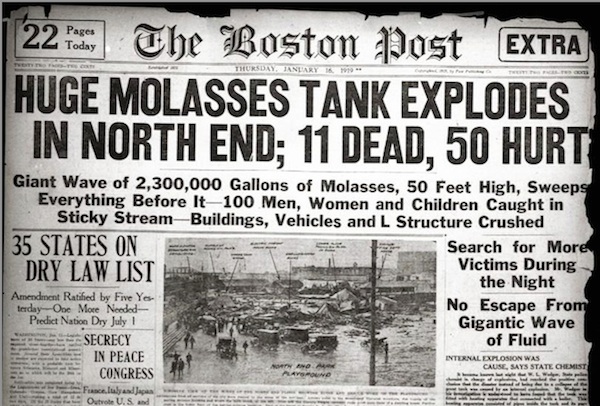
Boston Post Headline
The headline of the Boston Post the day after the disaster. Note the article on Prohibition on the left.

Now, nearly 100 years later, Boston and its surrounding areas are finally getting back into the game. As soon as I remembered the Molassacre, I wanted to use a local rum for this cocktail. I was a bit down to the wire and the liquor store I went to didn't have Bully Boy or Medford rum, which are actually made inside the city limits, but I came across Ryan & Wood's Folly Cove. It's made in Gloucester, which is about 35 miles north of Boston on Cape Ann. I'm not a rum connoisseur, but I really like it; it's smooth and has such a nice flavor that I enjoyed it by itself. But any rum distilled from molasses would work.

This recipe is a riff on the Dark 'N Stormy, which is usually made with Gosling's Black Seal Rum and ginger beer (in fact, Gosling's has trademarked the cocktail, so if you don't make it with Gosling's brand, you're technically not making a Dark 'N Stormy). Add some lime and you get a cocktail called a "buck," though that's not a term you really see anymore. The Moscow Mule (vodka, ginger beer, lime) is a vodka buck.

Blackstrap molasses is pretty thick and has a strong taste on its own, so I made a molasses simple syrup by adding it to sugar and water. And let me tell you, after working with it, I do not want to know what it would be like to drown in the stuff.

UPDATE: The Mixology Monday roundup is here!

Boston Molassacre

2 oz. rum
5 oz. ginger beer
1/2 oz. molasses simple syrup*
1 lime wedge

Combine rum and molasses syrup in a shaker with ice. Shake until chilled and strain into a rocks glass. Top with ginger beer and garnish with a lime wedge, squeezed and dropped in if desired.

*Molasses simple syrup: combine 1/4 cup sugar, 1/4 cup water, and 1 tbsp. blackstrap molasses in a small saucepan on the stove. Heat on low until sugar is dissolved. Do not allow to come to a boil. Let cool before use.

P.S. The map of Boston in the back of the top photo is from GeoArtShed. Check them out!