Quantcast
Garnish
Showing posts with label Falernum. Show all posts

Thursday, January 10, 2019

Chartreuse Swizzle

Chartreuse Swizzle

It's January, and you know what that means - it's time to Tiki the Snow Away! This midwinter celebration of all things Tiki was started by Dani DeLuca and Nic Titze. Living in Boston, it's usually a welcome escape from the cold and snow for me. This year is a bit odd - no snow to Tiki away and temperatures in the 40's. It's practically tropical.

If you missed my overview of the Tiki movement and its history last year, check it out. Tiki is all about kitsch and fun and crazy garnishes. It doesn't take itself too seriously. But you'd never be able to tell that given the cocktail recipes it has produced - elaborate, delicious constructions of juices and rums and spices. If you're interested in getting started making your own Tiki cocktails at home, definitely check out Martin Cate's book Smuggler's Cove.

Chartreuse Swizzle

Smuggler's Cove was where I found this recipe for the Chartreuse Swizzle, and I'm so glad I did. With no rum in sight, it's not a traditional Tiki cocktail, but it is a take on a very Tiki sort of drink, the swizzle. Swizzles are built in their tall glasses with crushed ice and traditionally mixed using a swizzle stick - not a little plastic thing like the one in these photos, but an actual branch from the aptly-named Swizzlestick Tree. The stick is rubbed between your palms, kind of like you're a Boy Scout trying to start a fire. The prongs at the bottom spin and mix the drink to frosty perfection. If you don't have a real swizzle stick (I don't), then a barspoon will do.

Chartreuse Swizzle

The Chartreuse Swizzle showcases everyone's favorite liqueur, Green Chartreuse. Mixed with lime, pineapple, and some Velvet Falernum, it's a bright and herbaceous, a perfect canvas for this unique spirit and a real standout among Tiki cocktails.

History: The Chartreuse Swizzle was created by Marcovaldo Dionysos of Smuggler's Cove itself in the early 2000's. It has since become one of the "new classics" of the cocktail world.

Chartreuse Swizzle

Chartreuse Swizzle

1.5 oz. Green Chartreuse
1/2 oz. Velvet Falernum
1 oz. pineapple juice
3/4 lime juice

Combine all ingredients in a tall glass and fill it with crushed ice until it is about 3/4 full. Insert a barspoon or swizzle stick and swizzle until the drink is chilled and the glass is frosty. Top with additional crushed ice. Garnish with a mint sprig and grated nutmeg.

Recipe from Smuggler's Cove: Exotic Cocktails, Rum, and the Cult of Tiki.

Friday, January 26, 2018

Zombie

Zombie

Today's #TikiTheSnowAway cocktail is another classic, perhaps second only to the Mai Tai in popularity: the Zombie. I have to say, this cocktail had somewhat negative connotations in my head before I saw the recipe. The name immediately conjured images of sugary cocktails laced with blue curaƧao. And for decades, if you ordered a Zombie at a bar, this is probably what you'd get. As I mentioned in my brief history of Tiki, Donn Beach kept his recipes carefully secret, to the point of using unmarked bottles and mysterious numbered mixtures simply labeled "Spices" or "Dashes." This, combined with the ubiquity of cheap, artificial mixtures in the second half of the 20th century, meant that any Zombie you would order at a Tiki bar would likely be a far cry from Donn's original.

Thankfully, Jeff "Beachbum" Berry is here to save the day again. He managed to find the original recipe, eventually piecing together that "Spices #4" referred to cinnamon syrup. The true Zombie was brought back from the dead, as it were.

Zombie

If you look at the recipe below, you'll see that it contains quite a lot of rum. If you thought the Navy Grog was strong, you should not go anywhere near a  Zombie. I swear I'm not trying to pick the most alcoholic Tiki recipes - these are the classics! But the Zombie is so strong that the menu at Don the Beachcomber informed patrons that there was a two-per-person limit, "for your own safety." As you can imagine, this just made the drink even more popular.

And its popularity is well-deserved. It's surprisingly good considering it's mostly rum. Or maybe that shouldn't be a surprise. The little bit of grapefruit juice does quite a lot, and the two dashes of Herbstura (Don's 1:1 mixture of Herbsaint and Angostura bitters) really adds some nice spice and herbal notes and brings it all together. It's a shockingly sophisticated cocktail.

But you probably should limit yourself to two, just in case.

History: Donn Beach invented the Zombie at Don the Beachcomber in 1934. The popular story is that a hungover businessman asked Donn to make him something to get him through a meeting, and Donn hastily mixed something up. Afterwards, the fellow told Donn that the drink made him feel like a zombie. However, the menu at Don the Beachcomber claimed, much to the contrary, that the cocktail was the result of months of careful experimentation on Donn's part.

Zombie

Zombie

1 1/2 oz. blended aged rum*
1 1/2 oz. column still aged rum*
1 oz. black blended overproof rum*
1/2 oz. Velvet Falernum
3/4 oz. lime juice
1/4 oz. grapefruit juice
1/4 oz. cinnamon syrup**
1 tsp. grenadine
1 dash Herbsaint
1 dash Angostura bitters

Combine all ingredients in a shaker tin with 12 oz. of crushed ice and a few large "agitator" cubes. Shake well or flash blend and open pour into a Zombie or Collins glass. Garnish with a mint sprig; I added a cinnamon stick and some appropriate sineage.

*I recommend checking out Smuggler's Cove for more info on how these rums differ and what brands to buy. I personally don't have a column still aged rum or a black blended overproof rum; I used Appleton Estate Signature Blend (actually a blended column still/pot still rum) and Gosling's Black Seal (which is not overproof). Plantation 5-Year was my blended aged rum. If you don't have a giant rum collection, use what you have - I think you'll still enjoy the cocktail quite a bit!

**For cinnamon syrup, combine 1/2 cup water and 2 cinnamon sticks in a saucepan and bring to a simmer. Add 1 cup sugar and stir to dissolve. Remove from heat and let sit for 12 hours. Then strain out the cinnamon sticks.

Recipe from Don the Beachcomber, adapted by Smuggler's Cove.

Saturday, January 6, 2018

Bar School: Tiki Cocktails

Jet Pilot

Tiki cocktails are an entire pool of drinks that I have barely even dipped my toe into on this blog. I think the Mai Tai and the Mari Koriko are the only ones I've made. At first, this was because I thought I wasn't a huge fan of Tiki. Like many people prior to the recent Tiki renaissance, I thought of Tiki drinks as saccharine beverages filled with fruit juices and cheap rum. After discovering that this is not at all the case, at least not anymore, I swung the other way - Tiki drinks seemed far too complicated, with multiple types of rum, exotic ingredients, and garnishes that even I find elaborate. Tiki was a bit intimidating. But as I've built up my bar, learned more about rum, and eagerly followed a number of other cocktail bloggers and Instagrammers with a healthy appreciation for all things Tiki, I've convinced myself that it's time to break into this world of beautiful, fantastical, delicious cocktails. Especially since this month is the #TikiTheSnowAway campaign on Instagram. Started by Drinkstagrammers Dani DeLuna and  Nic Titze, this opportunity to sip tropical beverages while watching the snow come down outside is hard to pass up. It's time to start learning about Tiki!

Tiki cocktails aren't just tropical drinks. In fact, some of the best known drinks that you might associate with the beach, like the Pina Colada or the Daiquiri, do not qualify. Cocktails like the Singapore Sling or Pegu Club, which actually were invented in southeast Asia, are not technically Tiki. Tiki is a very specific American cultural movement from the 1940's and 50's that involved everything from food to music to architecture. It is heavily influenced by Polynesia, but it's an Americanized homage with an endearing inauthenticity.

The word "tiki" comes from the Maori, the indigenous people of New Zealand. According to their legends, Tiki was the first man. The word also refers to small carvings and figurines that have humanoid shapes. How it became the moniker of a major cultural movement in America is a bit of a long story, one that I'll summarize briefly here. For more details, check out Smuggler's Cove by Martin Cate, where most of the information below came from.

The father of Tiki was a man named Ernest Gantt, who would later come to be known as Donn Beach. He grew up in New Orleans and spent a lot of time in the Caribbean and the South Pacific when he was young. In 1931, at 24 years old, he found himself in Los Angeles with no money and a whole lot of Polynesian souvenirs. He started renting them out to movie sets and consulting for films. Two years later, he opened a bar in Hollywood that would become Don the Beachcomber, after a pseudonym that he used during his less-than-legal activities in the Caribbean.
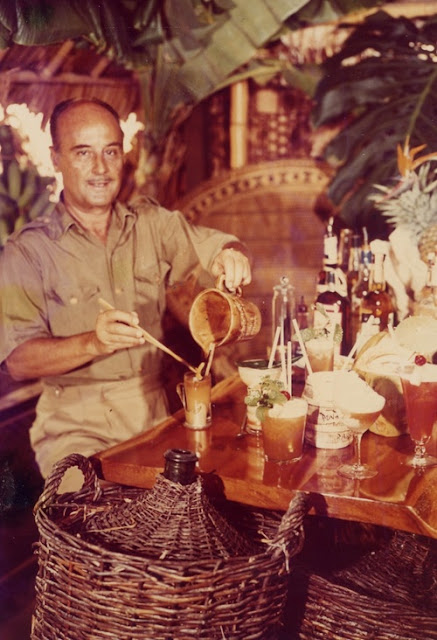
Donn Beach
Don the Beachcomber

The bar was something entirely new. Tropical-themed bars and nightclubs existed, but they were quite elegant and served the same kinds of drinks as everywhere else. Donn's bar was far more rustic and eclectic, designed to look like a beach hut filled with driftwood, fishing gear, and lots of assorted Polynesian artifacts. Donn also created an entirely new kind of drink to be served in this distinctive atmosphere. Working with the base recipe for Planter's Punch, he built cocktails that had "one of sour, two of sweet, three of strong, four of weak." He blended rums and citrus and spices and gave the drinks theatrical names. He also kept the recipes mysterious, using mixtures of ingredients in unmarked bottles so that no one could precisely copy his cocktails.

Don the Beachcomber became incredibly popular. Cate speculates that the Depression was the perfect time for this kind of fantastical, foreign bar experience. It gave people an escape from their troubles and provided a taste of the exotic for those who could not afford to travel. People were enchanted by the entire experience, and no one more so than a fellow named Victor Bergeron.

Trader Vic
Trader Vic

Bergeron owned a small restaurant and bar across from his parents' grocery store in Oakland. He traveled to New Orleans and the Caribbean in hopes of learning to make more exotic cocktails, but it was at Don the Beachcomber that he found his true inspiration. After visiting the bar in 1937, he went home and converted his restaurant into a Polynesian trading post and took the moniker Trader Vic. What Donn Beach had invented, Trader Vic perfected. He served his drinks in fancy mugs with elaborate garnishes. He created tropical cocktails with other spirits besides rum. He even pioneered an entirely new, Americanized twist on Chinese cuisine. The man invented both the Mai Tai and crab rangoon.

As both of these bars grew in popularity and expanded to multiple locations, Tiki exploded. The craze spread across the country, with thatched-roof restaurants filled with Polynesian carvings popping up left and right. But it wouldn't last. By the end of the 1960's, its popularity began to rapidly fade. Cate attributes this to the baby boomers and a growing sense of reality about what was going on in the world. Tiki suddenly seemed inauthentic or even offensive. As bars closed down, their signature recipes were lost. Those establishments that did stick around tried to clumsily reproduce them with the same sugary mixes and synthetic flavors that were popular during that dark age of cocktails. So Tiki got a reputation for being all about tacky decor and bad drinks.

Jeff Beachbum Berry
Jeff "Beachbum" Berry (photo from Liquor.com)

Until recently, that is, when the "Tiki Revivalists" began scouring antique stores for Tiki mugs and piecing together the old recipes in an effort to resurrect the true spirit of Tiki - not just the drinks, but the entire culture of Polynesian Pop that was born alongside them. Modern Tiki legend Jeff "Beachbum" Berry was responsible for rediscovering and distributing many of the classic Tiki cocktail recipes. Slowly but surely, the cocktail world got Tiki fever once again, and it seems like it might be here to stay. You can once again escape to a Polynesian paradise at San Francisco's Smuggler's Cove, Chicago's Three Dots and a Dash, Berry's own Latitude 29 in New Orleans, or countless others across the country. And home bartenders like me can learn to recreate these little pieces of the tropics at home.

So how do you make a Tiki cocktail? While Tiki culture is inspired by Polynesia, the drinks tend to be heavily influenced by Caribbean flavors and liqueurs. As developed by Donn Beach, they usually balance sour (lemon, lime, grapefruit), sweet (syrups, orgeat, grenadine), weak (pineapple juice, seltzer), spirit (traditionally rum), and spice (falernum, allspice liqueur, bitters). In modern Tiki, there has been a lot more experimentation and alteration of this formula, but the general idea is still there.

Jet Pilot

The Jet Pilot is a great starter Tiki cocktail. Invented in the 1950's at the Luau in Beverly Hills (another famous Tiki bar that's worth reading up about), it's a variation on a Zombie. It really shows how complex the flavors in these cocktails can be. Cinnamon, grapefruit, and three different rums offer a deceptively strong and incredibly tasty libation that will instantly transport you into the world of Tiki.

If, like me, you have a limited selection of rums in your home bar, that doesn't mean you can't still make and enjoy these drinks. It's helpful to learn a bit more about rum so that you can decide what the best substitutions will be. I have a little guide here, but I've learned a lot since I wrote it. There's lots of excellent information in Smuggler's Cove, which handily breaks down the rum into categories so you know what the best substitutions are. Other useful guides include this article on Beachbum Berry's six recommended rums and Inu a Kena's Rum 101. For my Jet Pilot, I didn't have a black blended overproof rum, so I subbed in a dark rum. If you're new to Tiki and to rum, it's unlikely that you'll notice too much of a difference!

Jet Pilot

Jet Pilot

1 oz. black blended rum (like Gosling's Black Seal)
3/4 oz. blended aged rum (like Diplomatico Reserva or Appleton Estate Reserve Blend)
3/4 oz. black blended overproof rum (like Lemon Hart 151)
1/2 oz. Velvet Falernum
1/2 oz. lime juice
1/2 oz. grapefruit juice
1/2 oz. cinnamon syrup*
1 dash Herbstura (1:1 Angostura bitters and Herbsaint)

Combine all ingredients in a shaker with crushed ice and a few large cubes. Shake until well chilled and pour into a double Old Fashioned glass or Tiki mug. No garnish is recommended, but feel free to go nuts!

*For cinnamon syrup, combine 1/2 cup water and 2 cinnamon sticks in a saucepan and bring to a simmer. Add 1 cup sugar and stir to dissolve. Remove from heat and let sit for 12 hours. Then strain out the cinnamon sticks.

Recipe adapted from Smuggler's Cove.

Monday, October 10, 2016

Lady Trent

Lady Trent

I’m quite excited to partner with Drizly to bring you today’s cocktail!

If you haven't heard of Drizly, it's an alcohol delivery service. It was started in Boston in 2013 by two Boston College graduates, and today it's available in 18 cities. For a $5 delivery fee, you can have the bottles of your choice delivered to your home within an hour. There's no markup - Drizly partners with local liquor stores and sells everything at their prices. They also sell mixers and ice!

My first encounter with Drizly was earlier this year when my brother, who lives in New Zealand, used it to send my husband a nice bottle of Japanese whiskey for his birthday. It was so convenient - he ordered it online, I got a notification and selected a delivery window, and it showed up at our door the next day. It might have even been the same evening. I was very impressed.


Appleton Signature Blend

When Drizly kindly offered to send me a bottle for this post, I jumped at the chance to order some Appleton Estate Signature Blend Rum (formerly called Appleton Estate V/X). Appleton is one of the most common Jamaican rums you find here in the States. As you may remember, varieties of rum differ from one another largely based on where they're made; each Caribbean island has its own style, largely influenced by whether they were colonized by the English, French, or Spanish. Jamaican rum is English-style. It's distilled in a pot-still and has a distinct flavor that most people refer to as a "funkiness." I'd never really gotten a handle on what on earth this means, so the first thing I did when my bottle arrived was was compare the Appleton to the two other aged rums I had in my bar: Barbancourt 3 Star from Haiti, which is a French-style aged rum made from sugarcane juice, and Folly Cove from Gloucester, MA, made from fermented molasses.

Lady Trent

The Appleton is, well... a bit funkier. It stands up to other ingredients better, holding its own with a rich, fruity flavor. It's also smoother and much more pleasant to drink on its own than the other two. I was pretty excited to use it in a cocktail.

I wanted to do a spirit-forward cocktail that would really feature the Appleton's distinct flavor. I started by playing with a rum version of the Japanese Cocktail, a classic made with Cognac, orgeat, and bitters. (For the uninitiated, orgeat is an almond syrup.) It was pretty good, but when I replaced the orgeat with Velvet Falernum, I felt like I'd stumbled upon something perfect.


Lady Trent

Falernum is a spiced syrup used in many Caribbean cocktails, flavored with ingredients like citrus zest, cloves, allspice, ginger, and almond. Velvet Falernum is an alcoholic version made in Barbados. It's basically a low-proof, sweetened, spiced rum. It did a wonderful job of enhancing the Appleton. Some orange and Angostura bitters rounded out the final product, which is a sort of a rum Old Fashioned. Despite all these big ingredients, it has a surprisingly delicate, almost floral flavor, which I decided to emphasize with a slender coupe and an orchid garnish.


Lady Trent

I named my new cocktail the Lady Trent after the main character in a wonderful series of books I've been reading by Marie Brennan. It seemed to fit - the drink is strong, exotic, and elegant.

The Appleton Estate is available from Drizly here!


Lady Trent

Lady Trent

2 oz. aged Jamaican rum (Appleton Signature Blend recommended)
1/2 oz. Velvet Falernum
1 dash Angostura bitters
1 dash orange bitters

Combine all ingredients in a mixing glass with ice and stir until chilled. Strain into a coupe and garnish with an edible flower.

Thanks to Drizly for making this post possible!

Thursday, September 29, 2016

Strange Brew

Strange Brew

September may be rapidly drawing to a close, but I still have a few more summery cocktail recipes to get out of my system! And most are from the Death & Co cocktail book, since I've been basically obsessed with it for the last few weeks. If you've already got a copy, bear with me while I share some of these delicious concoctions with the rest of the world.

If you're not familiar with Death & Co, it's a small bar that opened in Manhattan's East Village almost ten years ago, focusing on impeccably made craft cocktails in a welcoming, speakeasy-style environment. It was something of a revolutionary philosophy at the time, and the bar quickly soared in popularity. When I was in New York back in January, I managed to get in and get a seat at the bar right away because I was by myself. The cocktails were indeed superb, and the menu was so long and interesting that I could have spent the whole night reading it. (Unfortunately they were pretty strict about taking it back after I'd ordered, because apparently they have a big problem with people stealing them.)

Like the Flor de Jerez, the Strange Brew is one of the first recipes featured at the beginning of the book, which is how it caught my eye early-on. This beer cocktail is indeed a strange brew. The gin blends surprisingly with the pineapple and IPA, resulting in a flavor that was wholly unexpected for me - herbal, tangy, and a tiny bit bitter. It's very refreshing and summery, but quite unique.

Strange Brew


History: This cocktail was invented by Thomas Waugh when he was at Death & Co. in 2008. He's currently behind the bar at ZZ's Clam Bar, which looks like a truly unique establishment. The tiny, 12-seat restaurant serves gorgeous tiki cocktails with impeccable presentation, enhanced by the fact that the bartenders wear white tuxedo jackets, gold bowties, and no pants. Unfortunately, I don't think I'll be headed there any time soon, since GQ called it "the most expensive 58 minutes in New York dining."

Anyway, Waugh says in the Death & Co. cocktail book that he and his friends used to drink beer mixed with fresh fruit from the farmer's market in San Francisco, and that pineapple with IPA was always his favorite combination. He named this cocktail after a song by EMF, the B side to their extremely popular "Unbelievable."

Strange Brew

2 oz. gin (Tanqueray No. 10 recommended)
3/4 oz. Velvet Falernum
1 oz. pineapple juice
1/2 oz. lemon juice
Splash of IPA (Green Flash recommended)

Combine all ingredients except IPA in a shaker with three ice cubes (oddly specific, but then this is Death & Co) and give them a short shake. Strain into a Pilsner glass filled with crushed ice. Top with IPA and garnish with a mint sprig (as they recommend) or a slice of pineapple and a couple of pineapple leaves (as I did).

Recipe from Death & Co: Modern Classic Cocktails.

Thursday, May 12, 2016

Mari Koriko

Mari Koriko

Check it out, guys - I've gone full Tiki!

I've mentioned before how intimidated I am by Tiki cocktails, primarily because of how many different rums seem to find their way into a single cocktail. As anyone who reads this blog knows, my budget isn't unlimited, and I'm frequently guilty of substituting ingredients - Scotch for Japanese whiskey, dry vermouth for blanc, triple sec for Cointreau, etc. I would absolutely love to buy five or six different bottles of rum, but it's hard to justify. That said, I do love Tiki cocktails. They're fun, they're utterly drinkable, and they don't take themselves too seriously. And who doesn't love a fun cup and an elaborate garnish? So I hope to slowly ease myself into Tiki with some simpler recipes that use what I've already got in my bar. And in that spirit, I had to buy a Tiki mug. Check out this goofy guy I got from the Boston Shaker!

If you want some great Tiki recipes, check out Fred Yarm's blog Cocktail Virgin Slut. It's great for cocktails of all sorts, but the Tiki glassware and garnishes always catch my eye. It was here that I found the Mari Koriko, a Tiki cocktail that it seemed I could actually make. Dark rum, pineapple juice, Cherry Heering, Falernum, and lime. I know Cherry Heering and Falernum aren't things most people have in their bar, but it just so happens that I have both, and I'd say they're solid investments for your bar as well. Technically the recipe calls for Zacapa rum, an aged Guatemalan rum, but Fred used Gosling's, so that's good enough for me.

As you can maybe guess from the ingredients, the Mari Koriko is fruity and delicious. The dark rum is flavorful enough that it doesn't get swamped out by the other ingredients. I love the Cherry Heering, which gives it a beautiful, rich cherry flavor and, along with the Falernum, a hint of spice.

History: This cocktail comes from Sean Dumke at Knee High Stocking Co. in Seattle via Fred Yarm. There's a fantastic story behind its name. The word Tiki, it turns out, comes from the mythology of the Maori, the native people of New Zealand. In their tradition, Tiki was the first man. And Marikoriko was his wife, the first woman. They're basically the Maori version of Adam and Eve.

I think one reason I was particularly surprised by this is because I associate Tiki cocktails with Polynesia (a kitschy and Americanized version of it, but still), and I never thought of New Zealand as part of Polynesia. But it turns out that it is, both ethnically and geologically.

There's so much you can learn from cocktails!

Mari Koriko

1 1/2 oz. dark rum (Zacapa or Gosling's recommended)
3/4 oz. pineapple juice
1/2 oz. Cherry Heering
1/2 oz. Falernum (I used John D. Taylor's Velvet Falernum)
1/2 oz. lime juice

Combine all ingredients in a shaker with ice and shake until chilled. Strain into a rocks glass or an appropriately kitschy Tiki glass filled with ice. Garnish with a lime wheel and a cherry, or whatever else you can think of.

Recipe from Cocktail Virgin Slut.

Thursday, August 13, 2015

French Maid

French Maid

I've been on a ginger beer kick lately. One ginger beer cocktail tends to lead to another, especially when you buy it in a large bottle or six-pack. Loathe to let a mixer go to waste, I was flipping through The PDT Cocktail Book and came across the French Maid. I was a bit skeptical about mixing my nice Cognac with a can of Goslings, but I'm glad I did. Herbal and sweet with a hint of spice, this cocktail is delicious and incredibly refreshing. There's something beautiful about the way the flavors work together. I think you need the Cognac to really make it perfect. You could certainly use whiskey or rum and probably still make a darn good drink, but it wouldn't have the delicate sophistication of the French Maid.

I think this is the first cocktail I've written about that uses Velvet Falernum (pronounced fah-LEHR-num, if you were wondering). This is a spiced syrup that is most often used in Caribbean-style cocktails and tiki drinks. It has flavors of almond, citrus, cloves, and other spices. The taste is fairly subtle, especially when mixed with other ingredients, but it really adds an extra depth of flavor to a cocktail. Interestingly, you can buy alcoholic or non-alcoholic versions. The non-alcoholic sort is basically a flavored syrup. Fee Brothers makes one that should be pretty easy to find. But the variety I see used most often is John D. Taylor's Velvet Falernum. It's basically a very low-proof rum infused with sugar and spices, made in Barbados.

French Maid

History: Jim Meehan created this cocktail in 2008. It's based on the Kentucky Maid, which uses bourbon and foregoes the Falernum.

French Maid

1.5 oz. Cognac
3/4 oz. lime juice
1/2 oz. simple syrup
1/4 oz. Velvet Falernum
1 oz. ginger beer
4 cucumber slices, 1 reserved for garnish
4-6 mint leaves, plus a sprig for garnish

Muddle cucumber, mint, and simple syrup in the bottom of a shaker. Add Cognac, lime juice, Velvet Falernum, and ice. Shake until chilled. Strain into a rocks glass filled with ice. Top with ginger beer and stir gently. Garnish with a cucumber slice and a sprig of mint.

Recipe adapted from The PDT Cocktail Book.