Quantcast
Garnish
Showing posts with label Angostura Bitters. Show all posts

Wednesday, February 6, 2019

Widow's Touch

Widow's Touch cocktail

A few weeks ago, I featured a classic cocktail called the Widow's Kiss made with apple brandy, Benedictine, and Yellow Chartreuse. It's a good drink, but not really something I'd like to make again and again. A lot of older cocktails just aren't quite balanced for modern tastes, and even with PDT's adjusted recipe, the Widow's Kiss tastes like something from another time. To me that's part of the appeal.

Widow's Touch cocktail

The Widow's Touch, however, is another matter. I love this drink. It's an updated version of the classic that swaps out the Yellow Chartreuse for St. Germain, and the switch makes all the difference. In Vintage Spirits and Forgotten Cocktails, Ted Haigh calls the Widow's Kiss "a cocktail of fall turning towards winter." In that case, the Widow's Touch is a cocktail of fall meeting spring. It's bright, sweet, and floral with flavors of apple and pear.

Widow's Touch cocktail

History: The Widow's Touch sprang from Boston's fantastic bar scene. It was created by John Gertsen when he was at No. 9 Park. He went on to open Drink, one of Boston's best-known cocktail bars.

Widow's Touch

1 1/4 oz. Laird's Applejack or Apple Brandy
3/4 oz. St. Germain
1/4 oz. Benedictine
1 dash Angostura bitters

Combine all ingredients in a mixing glass with ice. Stir until well chilled and strain into a coupe glass.

Recipe from Bon Appetit.

Friday, January 25, 2019

Widow's Kiss

Widow's Kiss

It's been much too long since I featured a classic recipe - maybe not since the Clover Club back in September. Drinks that stand the test of time are always worth exploring. They provide such a unique connection to history. And if that's what you're looking for, the Widow's Kiss has it in spades. This recipe dates all the way back to 1895. We've been drinking this cocktail for 124 years!

To aptly describe the Widow's Kiss, I must quote Ted Haigh. In his book Vintage Spirits and Forgotten Cocktails, he writes:

As the scene opens, you are up in your grandmother's attic opening the dusty steamer trunk she brought from Europe in 1914. You reverently turn back layer upon layer of old lace and brocade, unveiling a packet of old love letters tied in silk ribbon. Ancient dried rose petals flutter down from between the envelope. 

That is what the Widow's Kiss is like.

I'm not sure I've ever read a more poetic and evocative description of a cocktail. I'd like to see a bar menu where all the drinks are described this way. After all, drinking cocktails is so often about the entire experience rather than just the flavor.

Widow's Kiss

In case grandma's attic isn't specific enough for you: the Widow's Kiss is a strong, herbaceous apple brandy drink made with Yellow Chartreuse and Benedictine. It's a spirit-forward sipper for sure, all apples, herbs, and sweetness. It's almost a touch savory as well. Definitely an interesting and complex drink, and one of the more famous Yellow Chartreuse cocktails.

History: The first mention of the Widow's Kiss is in the 1895 book Modern American Drinks by George Kappeler. Kappeler was the head bartender at Holland House, a fancy New York hotel on the corner of 5th Avenue and 30th Street. It's assumed that he created the recipe.

Haigh's recipe matches Kappeler's (1.5 oz apple brandy and 3/4 oz. each of the Benedictine and Chartreuse), but despite my devotion to cocktail history I decided to use the specs from The PDT Cocktail Book instead. I've come to trust PDT on the classics and thought that their version with less Benedictine and Chartreuse would be more to my taste.

Widow's Kiss

Widow's Kiss

2 oz. apple brandy or Calvados
1/2 oz. Yellow Chartreuse
1/2 oz. Benedictine
2 dashes Angostura bitters

Combine all ingredients in a mixing glass with ice and stir until chilled. Strain into a chilled coupe. No garnish.

Recipe and history from The PDT Cocktail Book.

Tuesday, November 20, 2018

Pumpkin Spice Old Fashioned

Pumpkin Spice Old Fashioned

It's a little hard to believe it's already Thanksgiving. Wasn't Halloween like last week? And to top it off, my extended family is celebrating Christmas on Thanksgiving day this year because most of us will be out of town in December. Definitely a condensed holiday season.

Thanksgiving is a perfect cocktail holiday. It already centers around sharing food and drink with friends and family. And there are so many fantastic flavors that we associate with autumn and Thanksgiving: cranberry, cinnamon, pecan, sweet potato, maple... and of course pumpkin! I've never put pumpkin in a cocktail before, but I did have a guest post on pumpkin cocktails a couple of years ago. I've been meaning to make one myself ever since. And since the pumpkin spice trend doesn't seem to be going anywhere anytime soon, it's high time to hop on the bandwagon.

This is a very simple Old Fashioned recipe made special by a pumpkin spice syrup. I tried a couple of recipes I found online and didn't think any of them had enough pumpkin in them, so this one is my own creation. You're going to want to whip up a big batch, because it is good in everything - try it in coffee or on ice cream! A jar of it would make a great gift for your host this Thanksgiving.

Pumpkin Spice Old Fashioned

Pumpkin Spice Syrup

1/2 cup water
1/2 cup brown sugar
1/2 cup pumpkin puree
3/4 tsp. cinnamon
1/2 tsp. ginger
1/2 tsp. nutmeg
1/4 tsp. cloves
1 dash cardamom
OR 2 tsp. pumpkin pie spice - I used Trader Joe's

Combine water and sugar in a saucepan and bring to a simmer, stirring until sugar is dissolved. Lower heat and add pumpkin and spices, whisking to combine. Let barely simmer for five minutes, whisking frequently. Then cover and let cool. Once the mixture has cooled, strain it through cheesecloth to remove the pumpkin solids. Store in the fridge.

Pumpkin Spice Old Fashioned

2.5 oz. bourbon
2 barspoons pumpkin spice syrup
1 dash Angostura bitters
1 dash pecan or walnut bitters (or another dash of Ango if you don't have this)

Build the drink in a rocks glass. Combine bitters and syrup, and then add bourbon and stir. Add a large piece of ice and stir briefly. Twist an orange peel over the drink and discard. Garnish with a cinnamon stick.

Friday, June 15, 2018

Bamboo

Bamboo cocktail

If you like cocktails and you haven't bought a bottle of Amontillado sherry yet, I highly recommend you try it. It's not a big investment nor a big commitment; a decent bottle runs under $20, and because it's a fortified wine like vermouth, it should be stored in the fridge and can eventually go bad. It's a unique ingredient because it has flavors like raisin, nuts, and spice, but is actually fairly dry. So it can add those flavors to a cocktail without adding sweetness. I've made a number of recipes with Amontillado that I absolutely love: the Sherry Cobbler, Teenage Riot, Toffee Negroni, Flor de Jerez, and Legend are a few I've posted, as well as a couple originals of mine: the Pear Tree and L'Orchid. 

Bamboo cocktail

Amontillado sherry plays a starring role in the Bamboo. This is a classic, turn-of-the-century cocktail that was extremely popular in its time. With the resurgence of interest in sherry cocktails, it's finally receiving some attention again. And not a moment too soon. This is a seriously tasty drink, particularly if you love sherry as much as I do. It has a nutty, raisiny flavor while still being surprisingly light. Also, without any hard liquor, the Bamboo is a relatively low ABV cocktail that still drinks like something more spirit-forward. As David Wondrich writes, it "looks like a cocktail, tastes like a cocktail, and punches like a six-year-old."

The first recipe for the Bamboo in print (see below) as well as the more famous version in Boothby's 1908 The World's Drinks and How to Mix Them, don't specify what kind of sherry should be used. As such, you'll see the Bamboo made with a number of different sherries besides Amontillado, as well as with both blanc and dry vermouths. But ever since the Death & Co book changed the way I made Sazeracs, I've trusted them on the classics. When their recipes stray from tradition, it's usually for the better. And I think that's true of their specs for the Bamboo. They use Amontillado sherry and blanc vermouth, which probably tastes more similar to the "French vermouth" of Boothby's day. They also add half a teaspoon of simple syrup, which makes the drink less dry and really helps the sherry shine.

Bamboo cocktail

History: According to Boothby, the Bamboo was invented by Louis Eppinger, a German bartender who worked in Yokohama, Japan, where he managed the Grand Hotel from 1890-1907. Most accounts of the Bamboo's creation claim that Eppinger came up with it while he worked at the Grand, and that the name is a reference to Japan. But the Bamboo pre-dates Eppinger's stint in Yokohama by several years. The recipe appears in the St. Paul Daily Globe in 1886, and by 1893 it appeared on menus in New York as a Boston Bamboo. It was extremely popular, and a pre-bottled version was even sold.

This timeline doesn't mean that Eppinger didn't invent the Bamboo. Before he worked in Japan, he tended bar in San Francisco, and may have invented the drink there, which would explain its gradual journey eastward over the years. But it's clearly an even older drink than most people assume - another little piece of history you can sip on in your own home.

Bamboo

1 1/2 oz. Amontillado sherry (Lustau)
1 1/2 oz. blanc vermouth (Dolin)
1/2 tsp. simple syrup
1 dash Angostura bitters
1 dash orange bitters

Combine all ingredients in a mixing glass with ice and stir until chilled. Strain into a coupe glass. Garnish with a lemon twist.

Recipe from Death & Co: Modern Classic Cocktails.
Historical information from Tuxedo No. 2, Cold Glass, and Imbibe!

Wednesday, February 7, 2018

Martinez

Martinez

I've covered a lot of the really classic cocktails on here, but the Martinez has been a glaring omission. It admittedly hasn't maintained the popularity of some other recipes from the same era - and I'll talk about why that might be - but as the likely ancestor of the modern Martini, it remains an essential drink to know. And it's pretty tasty in its own right.

The reason I haven't made a Martinez until now was because I wanted to make it properly, or at least as close to that as I could come. And that meant I needed a bottle of Old Tom gin. Here's a quick refresher of your gin history: the ancestor of modern-day gin is genever, which originated in Holland. This method of making grain alcohol and flavoring it with herbs like juniper became wildly popular in England during the early 18th century, when there was a heavy tax on alcohol imports and people had to make their own spirits, usually from sub-par grains that weren't good enough for making beer. Flavoring the resulting liquor helped mask this. Hanging a sign with a black cat outside of a drinking establishment was a signal that gin was served there, and so it became known as Old Tom. While less sweet and bready than genever, Old Tom is sweeter and maltier than modern dry gins.

Old Tom made its way to the states and was the gin used in the Tom Collins and other early gin drinks. However, a preference for drier cocktails developed and distilling methods improved, paving the way for classic London Dry gin and causing Old Tom to fall out of favor. But in our modern cocktail renaissance, of course there are distillers producing this classic gin once again. The easiest to find is Hayman's. It's also very affordable - I got my bottle for only $20.

The Martinez is in the same family as a Manhattan or Negroni in taste, but it has a distinct flavor and sweetness provided by the Old Tom and the maraschino liqueur. You certainly could make one with a drier gin, but the inclusion of Old Tom definitely affects the flavor and makes it an exciting link to a past era.

Martinez

History: As I mentioned in my post on the Martini, the history of the Martinez is quite murky. It is often attributed to Jerry Thomas, the "father of American mixology." He worked at the Occidental Hotel in San Francisco, and the story goes that he would mix this cocktail up for commuters catching the ferry to Martinez. But it was not included in the first edition of his Bartender's Guide, and there is no definitive proof that he created the recipe. The first mention of it in print is in O. H. Byron's 1884 Modern Bartender's Guide, three years before the recipe was published in the 1887 edition of Thomas' book. Byron's version is clearly a variation of the Manhattan, which gives us a pretty clear cocktail genealogy of Manhattan > Martinez > Martini.

I should note that there are a half-dozen other versions of the Martinez's origin, from a bartender in the town of Martinez whipping it up to it being a celebratory cocktail for a gold miner who struck it rich. But however the drink came about, it was soon quite popular.

So why didn't this popularity persist? One factor was certainly the decline of Old Tom gin and the preference for drier cocktails, as I mentioned above. It's thought that this turned the Martinez into the Martini. Additionally, a Martinez recipe usually calls for Boker's Bitters, which went out of production in 1906. The recipe was lost for over a century, until a man showed up at the London Bar Show with a small bottle. Dr. Adam Elmegirab studied the tiny sample for 18 months in order to replicate the original recipe. He began selling Boker's Bitters once again in 2009. If you don't have a bottle (like me), a combination of Angostura and orange bitters is a decent substitute.

And finally, there isn't really one definitive recipe for the Martinez. Even Byron's book wasn't clear on exactly how to make one. Byron provides two different recipes for the Manhattan - one with dry vermouth and one with sweet - and then instructs to swap the rye for Old Tom gin to make a Martinez. Both versions persisted, with the drier one experiencing more popularity for a time, but ultimately sweet vermouth won out, perhaps because it was what Jerry Thomas used. Even now, bartenders seem to consider the Martinez a drink that's open to interpretation, with different ratios of gin to vermouth and even additions such as curaçao or absinthe. I found multiple versions of the recipe and tried several to determine what I liked best. The winner is below.

Martinez

2 oz Old Tom gin
1 oz sweet vermouth
1/4 oz maraschino liqueur
2 dashes Boker's bitters
or
2 dashes Angostura bitters
2 dashes orange bitters

Combine all ingredients in a mixing glass with ice and stir until chilled. Strain into a cocktail or coupe glass and garnish with an orange twist and/or a brandied cherry.

Recipe adapted from The Kitchn.
Historical information mostly from Imbibe and Gin Foundry.

Friday, January 26, 2018

Zombie

Zombie

Today's #TikiTheSnowAway cocktail is another classic, perhaps second only to the Mai Tai in popularity: the Zombie. I have to say, this cocktail had somewhat negative connotations in my head before I saw the recipe. The name immediately conjured images of sugary cocktails laced with blue curaçao. And for decades, if you ordered a Zombie at a bar, this is probably what you'd get. As I mentioned in my brief history of Tiki, Donn Beach kept his recipes carefully secret, to the point of using unmarked bottles and mysterious numbered mixtures simply labeled "Spices" or "Dashes." This, combined with the ubiquity of cheap, artificial mixtures in the second half of the 20th century, meant that any Zombie you would order at a Tiki bar would likely be a far cry from Donn's original.

Thankfully, Jeff "Beachbum" Berry is here to save the day again. He managed to find the original recipe, eventually piecing together that "Spices #4" referred to cinnamon syrup. The true Zombie was brought back from the dead, as it were.

Zombie

If you look at the recipe below, you'll see that it contains quite a lot of rum. If you thought the Navy Grog was strong, you should not go anywhere near a  Zombie. I swear I'm not trying to pick the most alcoholic Tiki recipes - these are the classics! But the Zombie is so strong that the menu at Don the Beachcomber informed patrons that there was a two-per-person limit, "for your own safety." As you can imagine, this just made the drink even more popular.

And its popularity is well-deserved. It's surprisingly good considering it's mostly rum. Or maybe that shouldn't be a surprise. The little bit of grapefruit juice does quite a lot, and the two dashes of Herbstura (Don's 1:1 mixture of Herbsaint and Angostura bitters) really adds some nice spice and herbal notes and brings it all together. It's a shockingly sophisticated cocktail.

But you probably should limit yourself to two, just in case.

History: Donn Beach invented the Zombie at Don the Beachcomber in 1934. The popular story is that a hungover businessman asked Donn to make him something to get him through a meeting, and Donn hastily mixed something up. Afterwards, the fellow told Donn that the drink made him feel like a zombie. However, the menu at Don the Beachcomber claimed, much to the contrary, that the cocktail was the result of months of careful experimentation on Donn's part.

Zombie

Zombie

1 1/2 oz. blended aged rum*
1 1/2 oz. column still aged rum*
1 oz. black blended overproof rum*
1/2 oz. Velvet Falernum
3/4 oz. lime juice
1/4 oz. grapefruit juice
1/4 oz. cinnamon syrup**
1 tsp. grenadine
1 dash Herbsaint
1 dash Angostura bitters

Combine all ingredients in a shaker tin with 12 oz. of crushed ice and a few large "agitator" cubes. Shake well or flash blend and open pour into a Zombie or Collins glass. Garnish with a mint sprig; I added a cinnamon stick and some appropriate sineage.

*I recommend checking out Smuggler's Cove for more info on how these rums differ and what brands to buy. I personally don't have a column still aged rum or a black blended overproof rum; I used Appleton Estate Signature Blend (actually a blended column still/pot still rum) and Gosling's Black Seal (which is not overproof). Plantation 5-Year was my blended aged rum. If you don't have a giant rum collection, use what you have - I think you'll still enjoy the cocktail quite a bit!

**For cinnamon syrup, combine 1/2 cup water and 2 cinnamon sticks in a saucepan and bring to a simmer. Add 1 cup sugar and stir to dissolve. Remove from heat and let sit for 12 hours. Then strain out the cinnamon sticks.

Recipe from Don the Beachcomber, adapted by Smuggler's Cove.

Saturday, January 6, 2018

Bar School: Tiki Cocktails

Jet Pilot

Tiki cocktails are an entire pool of drinks that I have barely even dipped my toe into on this blog. I think the Mai Tai and the Mari Koriko are the only ones I've made. At first, this was because I thought I wasn't a huge fan of Tiki. Like many people prior to the recent Tiki renaissance, I thought of Tiki drinks as saccharine beverages filled with fruit juices and cheap rum. After discovering that this is not at all the case, at least not anymore, I swung the other way - Tiki drinks seemed far too complicated, with multiple types of rum, exotic ingredients, and garnishes that even I find elaborate. Tiki was a bit intimidating. But as I've built up my bar, learned more about rum, and eagerly followed a number of other cocktail bloggers and Instagrammers with a healthy appreciation for all things Tiki, I've convinced myself that it's time to break into this world of beautiful, fantastical, delicious cocktails. Especially since this month is the #TikiTheSnowAway campaign on Instagram. Started by Drinkstagrammers Dani DeLuna and  Nic Titze, this opportunity to sip tropical beverages while watching the snow come down outside is hard to pass up. It's time to start learning about Tiki!

Tiki cocktails aren't just tropical drinks. In fact, some of the best known drinks that you might associate with the beach, like the Pina Colada or the Daiquiri, do not qualify. Cocktails like the Singapore Sling or Pegu Club, which actually were invented in southeast Asia, are not technically Tiki. Tiki is a very specific American cultural movement from the 1940's and 50's that involved everything from food to music to architecture. It is heavily influenced by Polynesia, but it's an Americanized homage with an endearing inauthenticity.

The word "tiki" comes from the Maori, the indigenous people of New Zealand. According to their legends, Tiki was the first man. The word also refers to small carvings and figurines that have humanoid shapes. How it became the moniker of a major cultural movement in America is a bit of a long story, one that I'll summarize briefly here. For more details, check out Smuggler's Cove by Martin Cate, where most of the information below came from.

The father of Tiki was a man named Ernest Gantt, who would later come to be known as Donn Beach. He grew up in New Orleans and spent a lot of time in the Caribbean and the South Pacific when he was young. In 1931, at 24 years old, he found himself in Los Angeles with no money and a whole lot of Polynesian souvenirs. He started renting them out to movie sets and consulting for films. Two years later, he opened a bar in Hollywood that would become Don the Beachcomber, after a pseudonym that he used during his less-than-legal activities in the Caribbean.
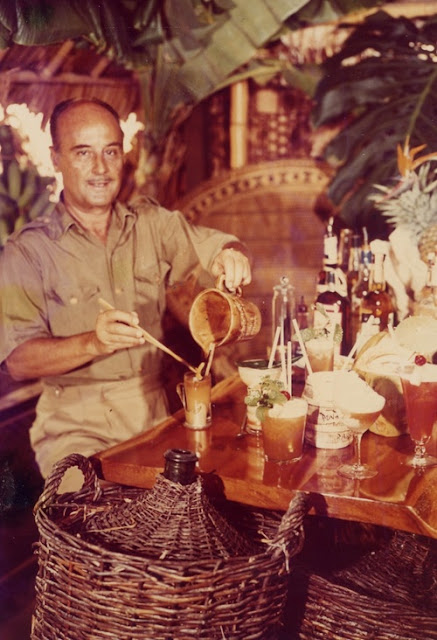
Donn Beach
Don the Beachcomber

The bar was something entirely new. Tropical-themed bars and nightclubs existed, but they were quite elegant and served the same kinds of drinks as everywhere else. Donn's bar was far more rustic and eclectic, designed to look like a beach hut filled with driftwood, fishing gear, and lots of assorted Polynesian artifacts. Donn also created an entirely new kind of drink to be served in this distinctive atmosphere. Working with the base recipe for Planter's Punch, he built cocktails that had "one of sour, two of sweet, three of strong, four of weak." He blended rums and citrus and spices and gave the drinks theatrical names. He also kept the recipes mysterious, using mixtures of ingredients in unmarked bottles so that no one could precisely copy his cocktails.

Don the Beachcomber became incredibly popular. Cate speculates that the Depression was the perfect time for this kind of fantastical, foreign bar experience. It gave people an escape from their troubles and provided a taste of the exotic for those who could not afford to travel. People were enchanted by the entire experience, and no one more so than a fellow named Victor Bergeron.

Trader Vic
Trader Vic

Bergeron owned a small restaurant and bar across from his parents' grocery store in Oakland. He traveled to New Orleans and the Caribbean in hopes of learning to make more exotic cocktails, but it was at Don the Beachcomber that he found his true inspiration. After visiting the bar in 1937, he went home and converted his restaurant into a Polynesian trading post and took the moniker Trader Vic. What Donn Beach had invented, Trader Vic perfected. He served his drinks in fancy mugs with elaborate garnishes. He created tropical cocktails with other spirits besides rum. He even pioneered an entirely new, Americanized twist on Chinese cuisine. The man invented both the Mai Tai and crab rangoon.

As both of these bars grew in popularity and expanded to multiple locations, Tiki exploded. The craze spread across the country, with thatched-roof restaurants filled with Polynesian carvings popping up left and right. But it wouldn't last. By the end of the 1960's, its popularity began to rapidly fade. Cate attributes this to the baby boomers and a growing sense of reality about what was going on in the world. Tiki suddenly seemed inauthentic or even offensive. As bars closed down, their signature recipes were lost. Those establishments that did stick around tried to clumsily reproduce them with the same sugary mixes and synthetic flavors that were popular during that dark age of cocktails. So Tiki got a reputation for being all about tacky decor and bad drinks.

Jeff Beachbum Berry
Jeff "Beachbum" Berry (photo from Liquor.com)

Until recently, that is, when the "Tiki Revivalists" began scouring antique stores for Tiki mugs and piecing together the old recipes in an effort to resurrect the true spirit of Tiki - not just the drinks, but the entire culture of Polynesian Pop that was born alongside them. Modern Tiki legend Jeff "Beachbum" Berry was responsible for rediscovering and distributing many of the classic Tiki cocktail recipes. Slowly but surely, the cocktail world got Tiki fever once again, and it seems like it might be here to stay. You can once again escape to a Polynesian paradise at San Francisco's Smuggler's Cove, Chicago's Three Dots and a Dash, Berry's own Latitude 29 in New Orleans, or countless others across the country. And home bartenders like me can learn to recreate these little pieces of the tropics at home.

So how do you make a Tiki cocktail? While Tiki culture is inspired by Polynesia, the drinks tend to be heavily influenced by Caribbean flavors and liqueurs. As developed by Donn Beach, they usually balance sour (lemon, lime, grapefruit), sweet (syrups, orgeat, grenadine), weak (pineapple juice, seltzer), spirit (traditionally rum), and spice (falernum, allspice liqueur, bitters). In modern Tiki, there has been a lot more experimentation and alteration of this formula, but the general idea is still there.

Jet Pilot

The Jet Pilot is a great starter Tiki cocktail. Invented in the 1950's at the Luau in Beverly Hills (another famous Tiki bar that's worth reading up about), it's a variation on a Zombie. It really shows how complex the flavors in these cocktails can be. Cinnamon, grapefruit, and three different rums offer a deceptively strong and incredibly tasty libation that will instantly transport you into the world of Tiki.

If, like me, you have a limited selection of rums in your home bar, that doesn't mean you can't still make and enjoy these drinks. It's helpful to learn a bit more about rum so that you can decide what the best substitutions will be. I have a little guide here, but I've learned a lot since I wrote it. There's lots of excellent information in Smuggler's Cove, which handily breaks down the rum into categories so you know what the best substitutions are. Other useful guides include this article on Beachbum Berry's six recommended rums and Inu a Kena's Rum 101. For my Jet Pilot, I didn't have a black blended overproof rum, so I subbed in a dark rum. If you're new to Tiki and to rum, it's unlikely that you'll notice too much of a difference!

Jet Pilot

Jet Pilot

1 oz. black blended rum (like Gosling's Black Seal)
3/4 oz. blended aged rum (like Diplomatico Reserva or Appleton Estate Reserve Blend)
3/4 oz. black blended overproof rum (like Lemon Hart 151)
1/2 oz. Velvet Falernum
1/2 oz. lime juice
1/2 oz. grapefruit juice
1/2 oz. cinnamon syrup*
1 dash Herbstura (1:1 Angostura bitters and Herbsaint)

Combine all ingredients in a shaker with crushed ice and a few large cubes. Shake until well chilled and pour into a double Old Fashioned glass or Tiki mug. No garnish is recommended, but feel free to go nuts!

*For cinnamon syrup, combine 1/2 cup water and 2 cinnamon sticks in a saucepan and bring to a simmer. Add 1 cup sugar and stir to dissolve. Remove from heat and let sit for 12 hours. Then strain out the cinnamon sticks.

Recipe adapted from Smuggler's Cove.

Tuesday, October 24, 2017

D-Day Rum Sazerac (+ Baby News!)

D-Day Rum Sazerac

Guess what? I had a baby! My son Luke was born at the end of September, and my husband and I have been busy figuring out this whole "parenting" thing for the last month. It's absolutely amazing. I was never a baby person, and I'm totally in love with this little guy. Everyone talks about how hard it is to care for a newborn - and it is hard! - but I wasn't expecting how much fun it is too. Although I think he was set to easy mode for the first two weeks, and recently decided we were ready for him to ramp things up... for the past few days, there's definitely been a lot more crying and a lot less sleeping. On both our parts.

Nonetheless, I'm so excited to get back to making, drinking, and posting cocktails! I know I mentioned my pregnancy a lot, but I promise I won't be constantly talking about Luke and posting baby pictures. We're all here for the cocktail recipes.

Oh, all right. If you insist. Just this once.

Luke!

I had a few people ask what my first drink was going to be after I had the baby, and I honestly didn't have one picked out. But the D-Day Sazerac was pretty high on my list. I tried it for the first time before I got pregnant and made it for some guests during the pregnancy. Everyone was raving about it, and I have to say I felt a bit bummed out sipping my club soda. I'm pretty thrilled to be drinking one at last.

This recipe switches up the traditional Sazerac by replacing the rye with Jamaican rum (the original recipe calls for Smith & Cross Navy Strength; I used Appleton Estate Reserve Blend) and sweetening the cocktail with Steen's Cane Syrup, a thick, dark, unrefined syrup that is a classic southern ingredient. If you can't get your hands on some, Demerara syrup or molasses is a fine substitute here. I like making mine with another Louisiana product, Cocktail & Sons Spiced Demerara Syrup. The fruity, funky flavor of the rum blends perfectly with the Herbsaint and bitters. It makes me want to try rum in lieu of whiskey more often.

D-Day Rum Sazerac

History: The D-Day Sazerac was created by Scotty Dagenhart at the Green Goddess in New Orleans. His inspiration for the drink is pretty cool: at one point, the bar was unable to get any of their usual rye whiskey, and this reminded Dagenhart of how the Hurricane was created during World War II when bars in New Orleans couldn't get their hands on whiskey but had plenty of rum. As the menu says, "We invented this to imagine New Orleans captured by German U-boats, leaving us without any rye whiskey to make our hometown Sazeracs." Dagenhart presumably chose D-Day for the cocktail's moniker because of the D-Day Museum (now the National World War II Museum) in New Orleans.

In the words of cocktail writer Michael Dietsch, "If that's wartime austerity, bring on the goddamn war."

D-Day Rum Sazerac

D-Day Rum Sazerac

2 oz. Smith & Cross Navy Strength Rum (I used Appleton Estate Reserve Blend)
1/4 oz. Steen's Cane Syrup (I used Cocktail & Sons Spiced Demerara Syrup)
1 dash Angostura bitters
1 dash Peychaud's bitters
Herbsaint rinse

Combine rum, syrup, and bitters in a mixing glass with ice and stir until chilled. Rinse an Old Fashioned glass with Herbsaint and strain in the cocktail. Garnish with a lemon twist.

Recipe adapted from The Nola Defender.

Wednesday, June 28, 2017

Old Fashioneds with Maker's 46

Spiced Old Fashioned with Maker's 46

Last week, Maker's Mark invited me to participate in their Father's Day webinar. Pamela Wiznitzer teamed up with David Shapiro of Trunk Club in Manhattan to help us make some cocktails and come up with some creative Father's Day gifts. In addition to showing us several ways to wrap a Maker's Mark bottle (my personal favorite was tying a bowtie around it and gifting them both), Pam showed us how to make a couple of different Old Fashioned recipes with Maker's 46. At first I thought, "Well, I know how to make an Old Fashioned." But then I realized that (a) my currently-posted Old Fashioned recipe is a bit old and contains a lot more "fruit salad" than I prefer these days, and (b) Pam had some pretty great ideas on how to make an excellent cocktail, all of which are below.

Old Fashioned Ingredients

I'm usually 1,500 miles away from my dad, and until this year my husband could only be considered a father to our adorable but badly-behaved dog, so I was really excited that my dad was coming up to Boston this past weekend and we could have a belated Father (and Father-to-be)'s day celebration with some Old Fashioneds. I set up all the ingredients we'd need for the two recipes Pam showed us and mixed up some drinks for the two of the most important men in my life (the third being the tiny one doing somersaults in my uterus right now). My dad also brought his incredibly nice Canon 6D and all of his expertise with Lightroom, so we got some great photos of the process!

Making an Old Fashioned

Maker's Mark can make for a very special Old Fashioned. I personally love using bourbon instead of rye, and as a wheated bourbon, Maker's is particularly sweet and rich. We made these cocktails with Maker's 46, a special bottle from Maker's Mark that is aged for 2-3 more months with additional French oak staves. It gives the Maker's a more intense flavor, rich with caramel, spice, vanilla, and toasted oak. The distillers experimented with several different barrels for the special bourbon, and the 46th was the one that worked - thus Maker's 46.

Making an Old Fashioned

For the first Old Fashioned, Pam kept it classic with Angostura bitters and regular simple syrup (1:1 ratio of sugar and water, either simmered and cooled or - as Pam suggested if you're pinched for time - shaken together in a mason jar until the sugar dissolves). Where she surprised me was suggesting a lemon twist instead of the usual orange twist. At first I was aghast - isn't that sacrilegious or something?? But she said it could really brighten up the flavors of the bourbon, and she was completely right. It was a nice twist on my usual recipe (no pun intended).

Making an Old Fashioned

For the second recipe, Pam used two really excellent ingredients: Cocktail & Son's Spiced Demerara Syrup, which I've tried before and loved, and 18.21 Barrel Aged Havana & Hyde bitters, which were new to me but are going to quickly became a favorite in my bar. This Old Fashioned was an entirely different experience, full of spice and smoke. An orange twist and star anise were the perfect garnish.

The dads had a great time catching up and enjoying the Old Fashioneds. I'm really lucky that my son is going to grow up with two such wonderful men in his life!

Dad and Dad-to-be

Simple Old Fashioned

2 oz. bourbon (Maker's 46 recommended)
2 dashes bitters
2 barspoons simple syrup
Lemon twist

In a mixing glass, combine bitters, simple syrup, and bourbon. Fill the glass with ice, stir briefly, and strain into an Old Fashioned glass over one large ice cube. Twist a lemon peel over the glass, rub it along the sides, and drop it in. Alternatively, you can build the drink in your glass.


Old Fashioneds with Maker's 46

Spiced Old Fashioned

2 oz. bourbon (Maker's 46 recommended)
9 drops 18.21 Havana & Hyde bitters (or other barrel-aged bitters)
1 barspoon Cocktail & Sons Spiced Demerara Syrup
Orange twist
Star anise

Combine bitters, syrup, and bourbon in a mixing glass. Add ice and stir briefly. Strain into an Old Fashioned glass over one large ice cube. Squeeze an orange peel over the glass, rub it along the sides, and drop it in. Garnish with star anise. Alternatively, you can build the cocktail in your glass.

Thursday, June 1, 2017

Mocktail: Old Cuban

Non-alcoholic Old Cuban

A couple of weeks ago, I was scouring the internet for good spots in Boston to grab a mocktail with a pregnant friend. Luckily, there are several articles out there discussing what bars and restaurants have good non-alcoholic options. One place that comes up repeatedly is, unsurprisingly, Eastern Standard. Their cocktails are fantastic, it made sense that they'd do an excellent job on their non-alcoholic options as well. A couple of sites listed one drink that they make in particular, a non-alcoholic version of an Old Cuban. This is one of my favorite cocktails, so I was definitely intrigued. I decided to try and make my own Old Cuban mocktail at home.

The Old Cuban is usually made with aged rum, mint, simple syrup, lime, bitters, and sparkling wine. The rum would be easy enough to omit, and the bitters could remain for my purposes. The real challenge was a substitute for the sparkling wine. There are all sorts of sparkling grape juices and ciders out there, but I find most of them too fruity and sickeningly sweet. Eastern Standard uses one I had never heard of called Fre Brut. Fre makes a variety of different non-alcoholic wines, and I had high hopes for the Brut. After all, Eastern Standard's endorsement means a lot. If it tasted anything like real champagne, I was ready to buy every varietal they sell - I'm definitely at the point in this pregnancy where I would love a glass of wine.

Non-alcoholic Old Cuban

Unfortunately, while the Fre Brut is tasty, it's still strongly reminiscent of the sparkling grape juice we used to have as kids on New Years Eve. I was hoping for something dry, but it's quite sweet. And indeed, the second and third ingredients after dealcoholized wine are grape juice and grape concentrate. I wonder what it would taste like if they left the wine as-is. If anyone knows of a drier non-alcoholic sparkling wine, let me know! I'd be all over it.

Still, I decided to proceed with my Old Cuban recipe, and I'm glad I did. I simply reduced the amount of simple syrup to make up for the sweetness of the Brut, and it turned out really, really good. It might be the closest in flavor to an actual cocktail that I've come. The fizz, the sour lime, and the familiar flavor of the Angostura work together to really mimic its alcoholic namesake. You might even be able to fool someone. I think it's the best mocktail I've made yet!

Booze it up: The alcoholic version of this drink is here.

Non-alcoholic Old Cuban

Old Cuban

9 mint leaves
3/4 oz. simple syrup
1 1/2 oz. lime juice
4 dashes Angostura bitters (omit if you are avoiding alcohol entirely)
4.5 oz. non-alcoholic sparkling wine (I used Fre Brut)

Combine mint leaves and simple syrup in the bottom of a shaker and muddle. Add the lime juice and bitters. Fill the shaker with ice and shake until chilled. Fine-strain into a coupe glass and top with the sparkling wine. Garnish with a mint leaf.

Monday, February 6, 2017

Devil's Backbone

Devil's Backbone

Before I talk about today's cocktail, some shameless self-promotion: a couple of weeks ago I submitted my Mediterranean Gimlet recipe to Nautical Gin's Gimlet contest, and now voting has begun. Check out all the entries on Nautical Gin's Facebook page and vote for your favorite by giving it a "like." You can find my recipe here - I'd appreciate your votes!

Whenever I'm feeling uninspired or I'm not sure what cocktail to make, I head over to Fred Yarm's blog Cocktail Virgin Slut. It's an incredible database of recipes - Fred posts at least one basically every day - and each one is accompanied by historical details, expert tasting notes, and often good suggestions for substituting the more unusual ingredients. A clickable list of spirits on the side of the page allows you to pick at least one thing you definitely want in your drink, helping to narrow down the vast number of recipes on the blog.

I was using this feature, browsing through the recipes that used amaro, when I came across the Devil's Backbone. It was really too intriguing to pass up. Two bitter liqueurs (Averna and Gran Classico) and a whole half ounce of peaty Scotch promised for a pretty intense cocktail. It seemed right up my alley.

Devil's Backbone

The Devil's Backbone smells intensely smokey with citrusy undertones. It's sweet and citrusy at the beginning of your sip, and then all the bitterness hits you, blending with smoke and peat at the end. It's big and complex and really wonderful - one of the best new cocktails I've made in a while.

If you're lacking some of the ingredients in this recipe, don't despair! You've got some options. For the Scotch, anything with a lot of smoke and peat will do - some examples are Laphroig, Lagavulin, Caol Ila, and Ardbeg. I used Compass Box's Peat Monster, which is a blended Scotch that I got for my peat-crazy husband - it's quite good. You could try subbing Amaro Montenegro or maybe Ramazzotti for the Amaro Averna. And Campari is a decent substitute for the Gran Classico; Fred used Campari when he made this drink.

History: Fred got this recipe from The Complete Cocktail Manual by Lou Bustamante, but it was originally created by Chris Lane at Lolinda in San Francisco. The idea behind the recipe was to use two whiskeys, two amari, and two types of bitters.

Devil's Backbone

1 oz. rye whiskey
1/2 oz. smoky single malt Scotch
3/4 oz. Averna
1/2 oz. Gran Classico
1 dash Angostura bitters
1 dash orange bitters

Combine all ingredients in a mixing glass with ice and stir until chilled. Strain into a coupe and garnish with an orange twist.

Recipe from Cocktail Virgin Slut.

Friday, December 16, 2016

Pear Tree

Pear Tree Cocktail

I've got some very exciting news! I've been selected as one of Drizly's Top Shelf Bloggers. I kind of can't believe that I'm on the same page as so many awesome cocktail blogs that I've been following for a while: Apartment Bartender, Gastronomista, Holly & Flora, Stir & Strain... the list goes on! Be sure to check out some of the other bloggers on the list. And, seeing as it's freeze-your-nosehairs cold in much of the US right now, don't forget that Drizly will deliver booze right to your door!

Yes, the temperature has dropped and the holidays are here. I kind of can't believe it. I usually spend so much time looking forward to Christmas, and this year we didn't even get a Christmas tree! I'm seeing festive cocktails popping up left and right on Twitter and Instagram, and I haven't really had time to get into the holiday spirit cocktail-wise. So during last night's frenzy of packing - we're flying home to spend the holiday in Louisiana with our families, where I believe it's a balmy 60 degrees - I made this holiday-appropriate cocktail and named it in honor of the Twelve Days of Christmas. I even came up with a little verse for it:

On the first day of Christmas, my true love gave to me...
A cocktail made with sherry!

I'm pretty sure you could write a whole song here... Four Roses, Three Olives, Two... um... well, I haven't really thought it all through yet.

Pear Tree Cocktail

I just love the flavors in this cocktail. Amontillado sherry is one of my favorite new ingredients, and I think it works really well here, adding its nutty and fruity flavor without contributing too much sweetness. It blends beautifully with pear juice and bourbon. In lieu of regular maple syrup, I used some Noble Chamomile & Vanilla Maple Syrup, which was a subtle but nice touch - their Bourbon Barrel Aged Maple Syrup would also be awesome. And it turns out all the syrups at Muddle & Stir are 25% off right now! Use the discount code syrup25. If you need some stocking stuffers, the Noble Maple Syrups are perfect.

Happy holidays!

Pear Tree

1 1/2 oz. bourbon
3/4 oz. Amontillado sherry
3/4 oz. lemon juice
1/2 oz. maple syrup (I used Noble Chamomile & Vanilla Maple Syrup)
1/2 oz. pear juice
1 dash Angostura bitters

Combine all ingredients in a shaker with ice and shake until chilled. Strain into a coupe glass and garnish with a candied pear*.

*For the candied pears, I adapted recipe from Adventuress (albeit in a very haphazard way - read on, but don't expect a precise recipe). I sliced the pear as thinly as I could, sprinkled both sides of the slices with sugar, and baked them on parchment paper at 300 degrees for at least an hour, maybe longer (it's going to depend a lot on the thickness of your slices). I checked them and flipped them roughly every 10 minutes. After 20 or 30 minutes, they had released a lot of juices, so I drained and replaced the parchment paper. I think I sprinkled on more sugar at 40 minutes or so. It took a long time to get them stiff enough to hold their shape when placed on the rim of a cocktail glass, and the thinner parts threatened to burn, so even slices is a must. Also, FYI, after 20-30 minutes they may not be stiff but they are delicious. Throw a few extra slices in for eating. :-)

Wednesday, November 23, 2016

Autumn Cocktail #2

Autumn Cocktail #2

Happy Thanksgiving, everyone! We're having one of the quietest ones we've had in a while. GarnishGuy is working a half day and we don't even have dinner plans yet. I've got a lot of work to do myself, so it doesn't really feel like much of a holiday. But I don't mind. We had our share of fun last weekend, when we went to New York with my sister and her husband. My travel companions let me drag them on a frantic quest to visit as many iconic cocktail bars as possible in three evenings. And we did a pretty decent job: Amor y Amargo, Death & Co., Dead Rabbit, Mother of Pearl, Mayahuel, Attaboy, PDT, and Dear Irving. Kind of a dream come true.

I think Attaboy was the highlight of the trip. From the hidden entrance and the atmosphere to the impeccable cocktails, it was just perfect. The drinks were even more impressive given that there wasn't a menu. I've had mixed success with that format at places like Drink in Boston, but our bartender at Attaboy was an utter genius; in the words of my sister, "He saw into my soul." For my first drink, I requested something bourbon-based with amaro, and he made me a drink called a Paycut with Fernet-Vallet, a Mexican(!) amaro I've never heard of. Every sip was heaven. I've got to figure out the recipe.

Autumn Cocktail #2

After drinks like that, my own offering for a fall cocktail feels a bit inadequate, but it's nice to have something to aspire to. Last year around this time I made my Autumn Cocktail #1, a fall-appropriate mixture of bourbon, apple cider, maple syrup, lemon, and cinnamon. For #2 this year, I kept the maple syrup and cinnamon and went with Laird's Applejack to bring in some apple flavor. The maple syrup makes this drink particularly special, because it's not just any maple syrup - it's Noble Bourbon Barrel Aged Maple Syrup.

Noble Bourbon Barrel Aged Maple Syrup

Guys. This maple syrup. Oh my gosh. If you'd told me prior to tasting it that I'd be recommending a $27 bottle of maple syrup, I'd have said you were completely nuts. But this stuff is spectacular. Other maple syrup pales in comparison to its rich, deep flavor. It's incredible in cocktails, and as a big fan of all carby breakfasts I'd really like to try it on some pancakes. If you want to snag your own bottle, you can get it at Muddle & Stir. If you're in Boston, I also recently saw it at Boston General Store in Coolidge Corner.

After the Applejack, syrup, and cinnamon, I tried a few different ingredients in this drink, and I did not expect Cynar to be the one that worked. As I mentioned in my post on amari, this is a bitter, artichoke-flavored liqueur that's somewhat like a more vegetal Campari. It's surprisingly versatile, and I love the way it works with the other flavors, adding a wonderful bitterness and depth to the cocktail. It's a fragrant glass of apple, cinnamon, and spice - perfect for fall!


Autumn Cocktail #2

Autumn Cocktail #2

1 1/2 oz. Laird's Applejack or Apple Brandy
1/2 oz. Cynar
1/4 oz. maple syrup (preferably Noble Bourbon Barrel Aged)
1 dash Angostura bitters
1 cinnamon stick

Combine all ingredients, including the cinnamon stick, in a mixing glass with ice. Stir until chilled. Strain into an Old Fashioned glass with one large ice cube. Garnish with an apple slice and a fresh cinnamon stick.

Monday, November 14, 2016

Brooklyn

Brooklyn

It's been a weird week, hasn't it? No matter what your politics, I think we can all agree that we deserve a drink after this election. And when the rest of the world seems a little off-kilter, there's nothing better than a classic cocktail to remind you how little a lot of things have changed.

The Brooklyn is, admittedly, not one of the most widespread classics. Its close cousin the Manhattan always steals the spotlight. I'd argue that there's a reason for this; I personally prefer the Manhattan with its sweet vermouth to the lighter Brooklyn. But the Brooklyn has inspired a number of spinoff cocktails that I really enjoy, most named after Brooklyn neighborhoods: the Red Hook, Greenpoint, Slope, Prospect Park, and many others. So it seemed like high time that I made one.

One reason I've avoided the Brooklyn until now is because it technically calls for an ingredient I don't have, a bitter orange liqueur from France called Amer Picon. It was invented in 1837 by Gaétan Picon, a distiller-turned-soldier who mixed up the quinine-laced bitters to cure the malaria he contracted while stationed in Algeria. It seemed to work, and the French army asked him to stay in Algeria and continue to produce it for the troops there. He opened multiple distilleries in the country, and when his "Amer Africain" won a major competition in London, he moved to Marseilles and began making the bitters under the name Amer Picon. They found their way into a number of turn-of-the-century cocktails, including the Brooklyn.

Unfortunately, the Picon company was sold around the 1970's, and the recipe for Amer Picon was changed and diluted (so much for nothing really changing). Besides a few precious bottles hoarded away by collectors, it's now impossible to taste the original formula. Even the altered version is not available for purchase in the United States. So you can't really make a "real" Brooklyn anymore. You can get around this problem by making your own Amer Picon substitute or just subbing in Angostura and orange bitters. I did the latter, including two dashes of each.

The Brooklyn is surprisingly light in flavor due to the dry vermouth. With the ingredients I used, it has almost a nutty flavor, with strong hints of cherry and vanilla. There was a lot of spice on the finish. It's a pleasant cocktail, but all in all it's not my favorite of the Manhattan family. I feel like it's crying out for sweet vermouth. But I'm still quite happy that I finally tried it. I'd like to replace the Amer Picon with some different amari and see how that improves things.

History: As I mentioned in my post on the Greenpoint, there are five cocktails that were created in the early twentieth century that were named after New York City's five boroughs: the Manhattan (rye, sweet vermouth, bitters), the Bronx (rye, sweet vermouth, dry vermouth, orange juice), the Brooklyn (rye, dry vermouth, maraschino liqueur, Amer Picon), the Queens (gin, dry vermouth, sweet vermouth, pineapple juice) and the Staten Island Ferry (rum, pineapple juice). It seems that the Manhattan came first and sparked a trend. Not to be left behind, Brooklyn bartenders began serving up a number of different cocktails named after their neighborhood.

The Brooklyn we know and love today was one of the earliest of these to appear on the scene. It popped up in J.A. Grohusko's Jack's Manual in 1908. It didn't really catch on at first (one could argue that it never really caught on, not the way the Manhattan or even the Bronx did), but it was included in Jacques Straub's 1913 Manual of Mixed Drinks and the famous Savoy Cocktail Book in 1930. Still, bartenders continued to invent their own Brooklyns, either ignorant of this one's existence or unsatisfied with it. Though the recipe flew under the radar until very recently, it did survive, and now it has a number of descendants created during the recent craft cocktail renaissance.

For much more on the Brooklyn's history, check out this article from Edible Brooklyn.

Brooklyn

2 oz. rye whiskey
1 oz. dry vermouth
1/4 oz. maraschino liqueur
1/4 oz. Amer Picon or a few dashes Angostura or orange bitters (I used two dashes of each)

Combine all ingredients in a mixing glass with ice and stir until chilled. Strain into a Nick & Nora glass and garnish with a brandied cherry.

Recipe adapted from Serious Eats. The history of Amer Picon came from Punch.

Monday, October 10, 2016

Lady Trent

Lady Trent

I’m quite excited to partner with Drizly to bring you today’s cocktail!

If you haven't heard of Drizly, it's an alcohol delivery service. It was started in Boston in 2013 by two Boston College graduates, and today it's available in 18 cities. For a $5 delivery fee, you can have the bottles of your choice delivered to your home within an hour. There's no markup - Drizly partners with local liquor stores and sells everything at their prices. They also sell mixers and ice!

My first encounter with Drizly was earlier this year when my brother, who lives in New Zealand, used it to send my husband a nice bottle of Japanese whiskey for his birthday. It was so convenient - he ordered it online, I got a notification and selected a delivery window, and it showed up at our door the next day. It might have even been the same evening. I was very impressed.


Appleton Signature Blend

When Drizly kindly offered to send me a bottle for this post, I jumped at the chance to order some Appleton Estate Signature Blend Rum (formerly called Appleton Estate V/X). Appleton is one of the most common Jamaican rums you find here in the States. As you may remember, varieties of rum differ from one another largely based on where they're made; each Caribbean island has its own style, largely influenced by whether they were colonized by the English, French, or Spanish. Jamaican rum is English-style. It's distilled in a pot-still and has a distinct flavor that most people refer to as a "funkiness." I'd never really gotten a handle on what on earth this means, so the first thing I did when my bottle arrived was was compare the Appleton to the two other aged rums I had in my bar: Barbancourt 3 Star from Haiti, which is a French-style aged rum made from sugarcane juice, and Folly Cove from Gloucester, MA, made from fermented molasses.

Lady Trent

The Appleton is, well... a bit funkier. It stands up to other ingredients better, holding its own with a rich, fruity flavor. It's also smoother and much more pleasant to drink on its own than the other two. I was pretty excited to use it in a cocktail.

I wanted to do a spirit-forward cocktail that would really feature the Appleton's distinct flavor. I started by playing with a rum version of the Japanese Cocktail, a classic made with Cognac, orgeat, and bitters. (For the uninitiated, orgeat is an almond syrup.) It was pretty good, but when I replaced the orgeat with Velvet Falernum, I felt like I'd stumbled upon something perfect.


Lady Trent

Falernum is a spiced syrup used in many Caribbean cocktails, flavored with ingredients like citrus zest, cloves, allspice, ginger, and almond. Velvet Falernum is an alcoholic version made in Barbados. It's basically a low-proof, sweetened, spiced rum. It did a wonderful job of enhancing the Appleton. Some orange and Angostura bitters rounded out the final product, which is a sort of a rum Old Fashioned. Despite all these big ingredients, it has a surprisingly delicate, almost floral flavor, which I decided to emphasize with a slender coupe and an orchid garnish.


Lady Trent

I named my new cocktail the Lady Trent after the main character in a wonderful series of books I've been reading by Marie Brennan. It seemed to fit - the drink is strong, exotic, and elegant.

The Appleton Estate is available from Drizly here!


Lady Trent

Lady Trent

2 oz. aged Jamaican rum (Appleton Signature Blend recommended)
1/2 oz. Velvet Falernum
1 dash Angostura bitters
1 dash orange bitters

Combine all ingredients in a mixing glass with ice and stir until chilled. Strain into a coupe and garnish with an edible flower.

Thanks to Drizly for making this post possible!